

Background
There remains debate about whether humans have done so much damage to the environment that we have created a new geological time period, the ‘Anthropocene’ (Lewis and Maslin, 2015; Witze, 2024). But what we can say with reasonable certainty is that, increasingly, over the past 500 years, carbon emissions from human activities have spiralled, tracked reasonably reliably by increasing Gross Domestic Product (GDP) (Our World in Data, 2024; Ritchie and Roser, 2020).
At the same time, media innovation has brought news of this great explosion of wealth into the palms of our hands, alongside apparently growing awareness of the harms it brings, not least from energy and resource use, and waste, from the very devices we can’t live without (Maxwell and Miller, 2012). Much has been done to increase our understanding of climate change, particularly in the news media by what is called ‘climate reporting’ (see for example: Centre for Climate Reporting, 2025). Campaigns, often with famous figureheads, have been mounted (see, for example: Climate Change – the Facts, 2019).
Yet, despite more than 50 years of global environmental discussions, we appear unable to act quickly enough in our own best interests. In October 2025, the World Meteorological Organization (2025) warned that, in 2024, there were record amounts of CO2 in the atmosphere. The summer of 2026 in Europe has already been similarly ‘record-breaking’ (Rizzini, 2026, np).
Fuchs (2008) may suggest this is because environmental problems are social problems at their source. Steffen et al. (2015) urge that the decisions that need to be made cannot be made by scientists. Indeed, climate scientist Kevin Anderson (2023; 2025) and others (Anderson, Broderick and Stoddard, 2020; Chancel et al., 2022; Khalfan et al., 2023) now forcefully highlight that it is economic inequality, between and increasingly within nations, that has become the ultimate source of what makes the news as climate change. This is a social problem that Anderson (2023; 2025) highlights relates to the fact that senior academics, journalists and politicians, those who influence others, likely all represent high emitters (see also: Chancel et al., 2022; Khalfan et al., 2023), presenting challenges when these people are required to report on this issue or design relevant interventions.
Lewis (2013) suggests that one of the reasons we failed to anticipate the 2008 financial crash was the close relationship between economics journalists and the banking sector they were supposed to hold to account. Further to this, what does it mean, for example, when most BBC frontline presenters get paid upwards of £200,000 per year (BBC, 2025)? Even by UK standards, these workers are in the top 1% of UK earners (HM Revenue & Customs, 2025), meaning they are also very likely leading unsustainable lifestyles (Khalfan et al., 2023). Can they objectively discuss the who and how of the lifestyle change that is needed to control environmental harms?
The purpose of this study is to evidence where ‘sustainability’ issues (see, for example: Raworth, 2012) may be present in the news media’s output, or its ‘cultural emissions’, and link these with normative press theories (Siebert, Peterson, and Schramm, 1976) and values theory (Schwartz, 1992). The objective is to show that widely adopted ‘social responsibility’ approaches, representing the valuing of unbridled ‘freedoms’, may be at odds with sustainability, thus driving us away from social change and towards climate change.
Literature Review
Understanding values
Most in the news industry will be familiar with ‘news values’ (Harcup and O’Neill, 2001; 2016), but even such widely cited authors acknowledge that this idea only provides part of an explanation for why people may select, write or ultimately read the stories that we do. Our ‘values’, more generally, are identified (Kleanthous and Peck, 2006; Jackson, 2017), alluded to (Peterson in Siebert, Peterson, and Schramm, 1976; Wallerstein, 2004; Peck et al., 2004) and criticised (Bonneuil and Fressoz, 2017; Maxwell and Miller, 2012) across disciplines.
In international political economy, the oft-forgotten Susan Strange, who did see the financial crash coming, argues that it is the prioritisation of ‘values’ (1989, p. 5) in society that determines the importance of relevant power structures. She calls these values: ‘Justice’, ‘Freedom’, ‘Security’ and ‘Wealth’. In social psychology, Schwartz’s highly influential and widely tested ‘theory of basic human values’ (Schwartz et al., 2012, p. 663) typically identifies 10 value sets, which can be grouped into four, and map neatly onto Strange’s original conception, as in Figure 1.
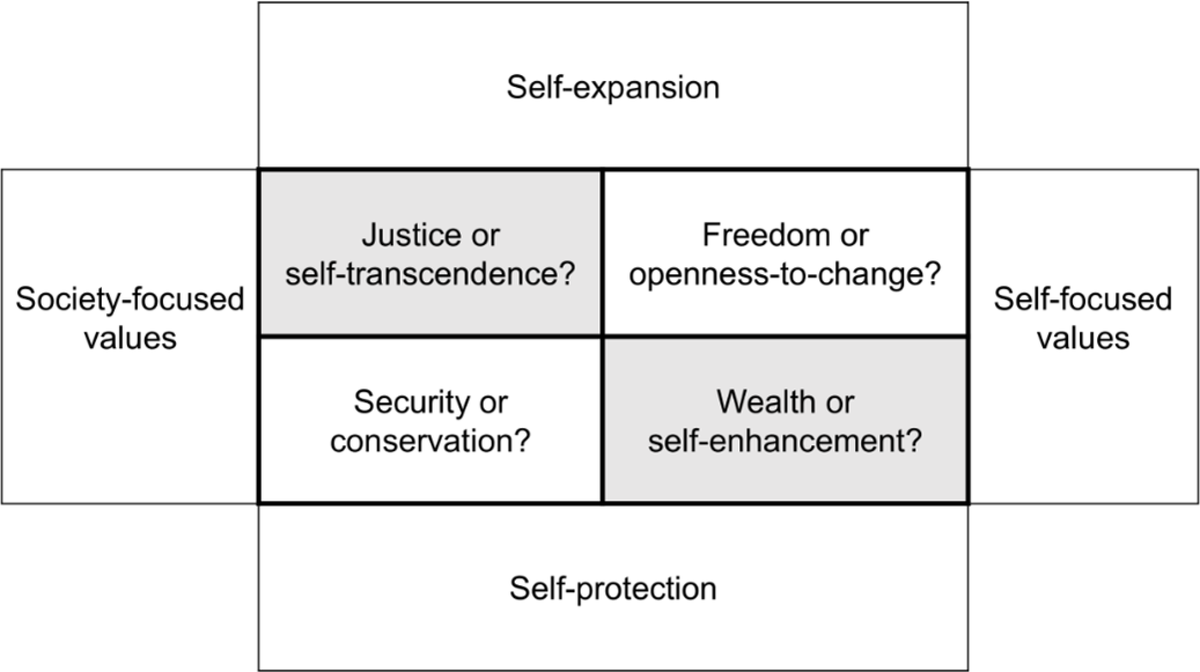
Figure 1: Basic human values (Combining Strange, 1989; Schwartz et al., 2012).
For proponents, values matter because they can influence what we all think and do, and the more we make use of certain ones, the more pronounced they can become (Holmes et al., 2012). These values can be considered across different axes, such as where we may prioritise others or self, ‘self-expansion’ or ‘self-protection’, or, looking from ‘Justice’ to ‘Wealth’, the prioritising of values that offer either intrinsic or extrinsic reward, meaning things that feel inherently worthwhile or things that are only done for external validation.
In the recent UK Journalists in the 2020s research led by the Reuters Institute, ‘personal values’ were found among the top-10 influences on media workers surveyed, influential for more respondents overall than ethics (Thurman et al., 2025). Yet, while ethics in journalism have for a long time been considered a key driver of behaviour (Siebert, Peterson, and Schramm, 1976), there is limited research about the values of news media workers, and thus their potential influence on news media output (Roderiques and Styles, 2026).
Given news media workers’ role in selecting and prioritising what information other people see, their values may have a particularly powerful effect on what we all think and do about pressing social issues.
Linking values, press and sustainability theories
The seminal normative, or values-based, press theories of ‘Authoritarian’, ‘Libertarian’ and ‘Social responsibility’ (Siebert, Peterson, and Schramm, 1976) inform Western media scholarship, where recent researchers typically advocate for the latter (Adams-Bloom and Cleary, 2009; Olkkonen, 2015; 2018).
To understand what these theories may have meant in practice in places like the United Kingdom and the United States, and in particular, whether they may encourage sustainable or unsustainable behaviour, they can initially be given historical context. We might observe in Figure 2 how each came in tandem with sweeping economic changes, namely colonialism starting around the 1600s, industrialisation around the 1800s and globalisation around the 1900s (Maxwell and Miller, 2012). We can actually see carbon emissions, GDP and media innovation all exploding at the time of the ‘Great Acceleration’ after World War II, just as the ‘social responsibility’ press theory starts to become more widely discussed and potentially adopted (Peterson in Siebert, Peterson, and Schramm, 1976).
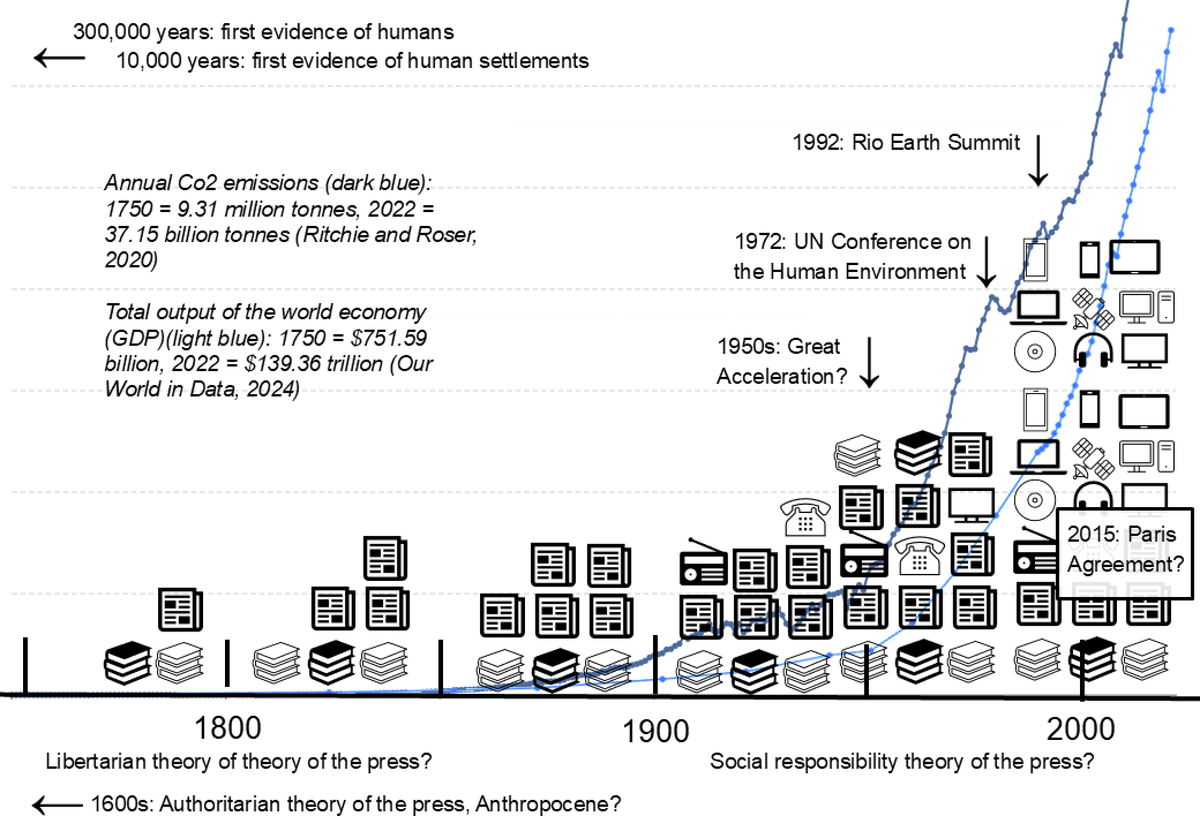
Figure 2: A timeline of ‘creative destruction’ (Combining: Siebert, Peterson, and Schramm, 1976; Maxwell and Miller, 2012; Ritchie and Roser, 2020; Our World in Data, 2024).
More general ‘sustainability’ theories are similarly found across time and space (Barbier, 1987; Daly, 1993; McElroy, Jorna, and van Engelen, 2008; Rockström et al., 2009; Raworth, 2012) and can help us further understand the implications of these press theories.
One of the most widely cited conceptions comes from the United Nations’ (UN) Our Common Future report, where it is imagined that ‘sustainable development’ ‘meets the needs of the present without compromising the ability of future generations to meet their own needs’ (Brundtland, 1987, p. 16). Though conceived of separately, this idea is considered to encompass three aspects, ‘the economic’, ‘the environment’ and ‘the social’ (Barbier, 1987), but there may well be more ‘sustainabilities’ besides.
Despite this language being widely adopted across the world (see, for example: United Nations, 2015), typically, those appearing to adopt or balance these aspects have been found to accept ‘trade-offs’ (Barbier, 1987, p. 104), where in fact ‘the economic’ has been allowed to dominate at the expense of ‘the environment’ and ‘the social’ (Maxwell and Miller, 2012). Many have credibly demonstrated the limits to economic growth (Meadows, Randers, and Meadows, 2009) and ‘sustainable growth’ is considered a ‘bad oxymoron’ (Maxwell and Miller, 2012, p. 31).
A close reading of the work of the Responsible Media Forum industry body (previously the Media CSR Forum) reveals these tensions in their logic. Though the organisation has long discussed climate change and environmental management (Ceasar and Hodgson, 2008), the ‘corporate social responsibility’ issues prioritised over time are broadly legal-financial, because these are considered most likely to immediately affect the ‘bottom line’, followed by editorial priorities, then socio-environmental concerns (Responsible Media Forum and Carnstone, 2018).
The organisation, in fact, suggests editorial concerns around something like impartiality are inherently in conflict with ‘promoting’ socio-environmental issues (Towe, Witte, and Toennesen, 2020). Yet such a concern about ‘campaigning’ is not raised about promoting economic issues, via things like share indexes or economics sections, even though the relationship between advertising and editorial is a longstanding concern of media sustainability advocates (SustainAbility and Ketchum, 2002). On top of this, concerns are raised where news media organisations, in particular, may be accused of hypocrisy if they are found to be holding others to account on this when they are not doing ‘enough’ as an organisation (Towe, Witte, and Toennesen, 2020).
Meanwhile, a more convincing ‘sustainability’ theory has been demonstrated in the ‘safe and just’ model created by economist Kate Raworth (2012), where she highlights the need to build up the social foundations for those in most need, while bringing ‘overshooting’ lifestyles back from environmental ceilings (Rockström et al., 2009), effectively pursuing greater social freedom but requiring greater economic control (McElroy, Jorna, and van Engelen, 2008), particularly today for certain people in particular places (Rockström et al., 2021). This model was informed by and has now been adopted by environmental scientists (Rockström et al., 2021).
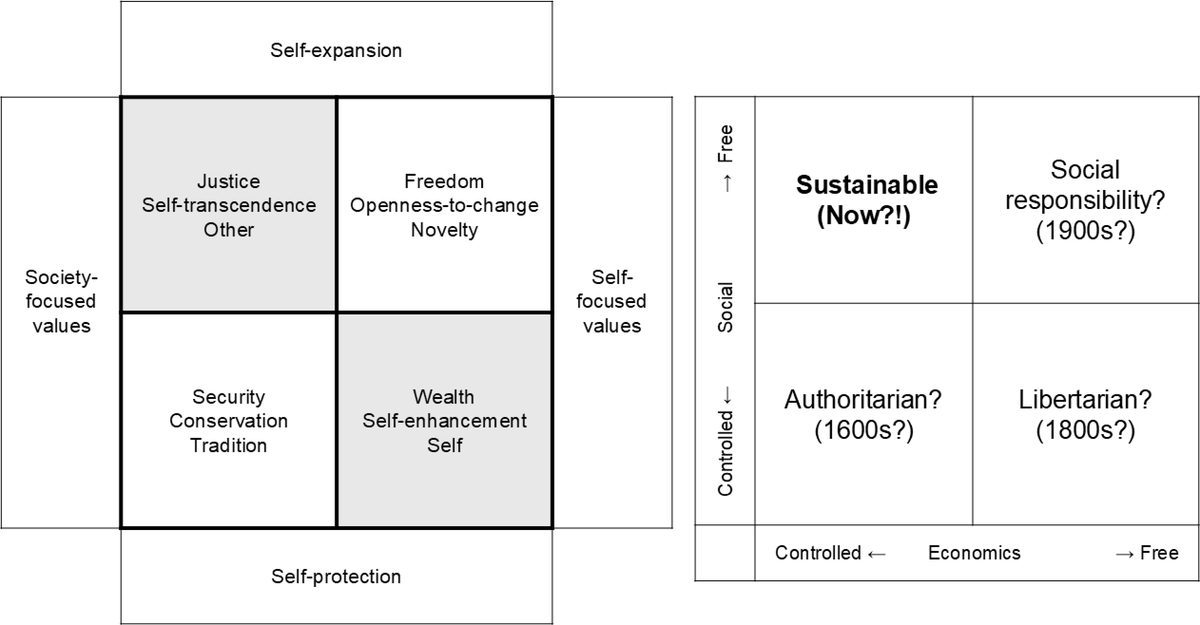
Taking theories of the press alongside theories of values, and given what we know about the world today, we may see that the dominant ‘social responsibility’ theory (see, for example: Towe, Witte, and Toennesen, 2020; Witte, Okolo, and Towe, 2022) promotes both economic and social freedom, and thus may best reflect values of ‘Freedom’ (Strange, 1989), ‘Openness to change’ (Schwartz et al., 2012) or ‘Novelty’ (Jackson, 2017). This means it may be at odds with sustainability.
‘Sustainable journalism’, echoing Brundtland, has been conceptualised as journalism that ‘meets the information needs of the present without compromising the ability of future generations to meet their own journalistic information needs’ (Berglez, Olausson, and Ots, 2017, p. xxii). But using the framework in Figure 3, it can be more specifically defined as journalism that promotes greater social freedoms, while accepting the need for more economic control, combining to reduce environmental harms. And it may thus reflect the valuing of ‘Justice’ (Strange, 1989), ‘Self-transcendence’ (Schwartz, 1992), or ‘Other’ (Jackson, 2017).
Defining cultural emissions
‘Cultural emissions’ (Styles, 2026) offer a new way to understand and measure ‘content’. Like environmental emissions, these are released by many if not all organisations, and individuals too, into our ‘cultural commons’ (Lopez, 2012). These cultural emissions likely have the power to influence people’s behaviour, with real effects on both culture and nature. These effects can be called ‘brainprint’, a poorly defined and measured phenomenon coined by a consultancy firm working alongside the World Wildlife Fund (WWF) UK (Peck et al., 2004), echoing notions of environmental footprints.
The Responsible Media Forum has been working for almost 20 years to understand how to measure this brainprint, or the effects of content. Hodgson, Toennesen, and Mimmack (2013) state that ‘[a]rguably, the biggest social and environmental impact of media is through its content’ (p.11). But they explain that understanding and measuring this is ‘fearsomely complex’ (ibid). Toennesen, Hodgson, and Mimmack (2013) put this down to the ‘unpredictability’ (ibid) of impacts on particular people and difficulties with ‘attribution’ (ibid, p. 33) of impacts to particular pieces of content.
There is now wide industry acknowledgement, at least among those focused on ‘responsibility’, of the ‘dual’ impacts that news media organisations have (see for example: Towe, Witte, and Toennesen, 2020), both as companies via their ‘footprint’, and also as producers of content, via this thing we can call brainprint. Indeed, the Responsible Media Forum (2021) has encouraged media companies including Channel 4, ITV, Informa, Pearson, Sky and Virgin Media to sign its Climate Pact, committing to Science-based Targets (SBTI, 2020) on managing their environmental footprints, as well as ‘behaviour change… [through] climate-related content’ (Responsible Media Forum, 2021, p. 3). Yet, it is difficult to find studies that provide evidence of such effects.
Looking specifically at content, media sustainability initiative albert (2021) measured ‘how UK broadcasters are exposing audiences to climate change through their content’ (p. 1) using subtitle data from broadcasts in 2018, 2019 and 2020, excluding news. This content analysis showed that ‘dog’, for example, was a top-four word over the period and mentions had increased by almost three times from 105,245 to 286,626. Something like ‘carbon emissions’ increased more than fourfold over this period, from 222 to 1,104. They also observed greater reference to environmental issues that have less impact overall, focusing on ‘waste’ and ‘food’ over ‘transport’ and ‘energy’.
Ruiu (2021) studied UK newspapers’ climate coverage over three different time periods and identified frames and changes in framing. She observed that alarmism may be counterproductive to engagement, as well as a ‘disappearance of optimism in conservative newspapers … [yet] the presence of both mockery and alarm around the consequences in the same political group can contribute towards creating a ‘confusing image’ of climate change’ (ibid, p. 488).
A Carbon Brief study (Gabbatiss et al., 2022) looked at more than 400 environment-focused newspaper editorials published since 2011. Editorials were chosen as these were considered to represent what the organisation is telling its readers about what it thinks. They found differences in support for different solutions to our problems, namely fracking, nuclear or renewables, depending on the observed politics of the newspaper. Overall, renewables appeared to be more criticised over time.
The Media and Climate Change Observatory (MeCCO) has been publicly tracking mentions of ‘global warming’ and ‘climate change’, now from more than 100 multimedia news sources in more than 50 countries, since 2017 (MeCCO, 2024, np). Yet, a commentary from this team questions whether ‘more’ means ‘better’ informed (Boykoff, Daly, and McAllister, 2021). They called for more research that explores this in detail.
Perhaps the most convincing measure of something like ‘brainprint’ comes from an advertising industry advocacy organisation called Purpose Disruptors. They calculate ‘advertised emissions’ (Kite et al., 2022, p. 1) as the greenhouse gas emissions (CO2e) resulting from the increase in sales produced by advertising – and they align their work with World Advertising Research Center (WARC) (2024) categories that measure advertising effectiveness. Motoring advertising, despite the fact that it doesn’t include sales of fuel for vehicles, is found to be the most polluting category.
The dominance of the ‘motor car’ in our minds has been termed ‘motonormativity’ (Walker et al., 2023, p. 21), and this relatively ubiquitous behaviour is demonstrated to have helped us drive past environmental limits (Bonneuil and Fressoz, 2017; Anderson, 2023). The Department for Transport in the United Kingdom particularly points to SUV sales since 2016 as the reason for stalling transport emissions reductions (DfT, 2020).
Perhaps unlike environmental emissions, the release of cultural emissions could prove beneficial, such as by encouraging people to change unsustainable behaviours (Simms and Murray, 2023). This study seeks to understand the news media’s cultural emissions, evaluating output for potential effects, which avoids the complexity of having to know outcomes or impacts, and highlights that perhaps the news media can be held accountable for harmful cultural emissions alone.
Methodology
Content analysis has a long history in media research, including those interrogating the workings of media companies (Adams-Bloom and Cleary, 2009; Gulyás, 2011; Hou and Reber, 2011; Ingenhoff and Koelling, 2012; Jaehnig and Onyebadi, 2011; Lacy, 1986; Rodgers, 2007). Several key studies already discussed have looked specifically at environmental editorial coverage (Gabbatiss et al., 2022; Painter and Ashe, 2012; Ruiu, 2021), but these miss important ‘cultural emissions’ categories. ‘Sustainability’ is not just about ‘the environment’ (Raworth, 2012), and there is a particular tension observed between ‘the economic’ and ‘the environment’ (Daly, 1993; Maxwell and Miller, 2012). Similarly, the news media’s ‘cultural emissions’ are not only editorial (Henriques, 2007).
For this study, a sample of 1,772 ‘content units’ were coded from the Daily Mail and the Guardian at four key environmental moments (1972, 1992, 2015, 2021). These publishers were chosen because they were the two most popular companies identified by Ofcom (2020) with different economic structures, enabling the researcher to understand whether economics plays a part in the sustainability of their ‘cultural emissions’. Though these newspapers’ perspectives are observed to be, and indeed are, politically different, economic structure is considered most important here because of how trade-offs are made in sustainability to favour economic concerns. We may even consider that it is the economic structure that makes them politically different.
The peculiar Scott Trust organisation, created by the son of the Guardian’s legendary editor C.P. Scott, who was himself the nephew of the company’s founder, owns this newspaper. This means that it has only one shareholder, the trust, which is managed by trustees who do not take a dividend, and any losses the company makes are underwritten by the investments made (Edge, 2022). The stated aim of this structure was ‘to secure the financial and editorial independence of the Guardian in perpetuity’ (Guardian News and Media, 2026, np).
The Daily Mail and General Trust was listed on the London Stock Exchange in 1932, so it had external shareholders receiving profits from the increasingly varied work of the business, but it was broadly delisted in 2022 after its equity shares were bought by Lord Rothermere, great-grandson of the original owner, and the company’s profits were thus taken private (Daily Mail and General Trust, 2024). The content analysis was completed before this change.
Though purposive samples have been criticised (Riffe et al., 2019) as they do not allow for wider generalisability, they have been very widely used in journalism research (Riffe and Freitag, 1997) and can help researchers home in on important issues.
These ‘content units’ were initially coded with ‘topics’ and ‘subtopics’, created by combining an industry dataset (Newman et al., 2020) with an exemplary PhD thesis in this field (Thomas, 2016). Strangely, though Ofcom does an annual survey of ‘news consumption in the UK’, it does not define ‘news’ (see: Ofcom, 2020).
In total, the top-level topics were:
Brand (about the publisher)
Culture
Economics
Education
Environment
Foreign affairs
Fun
Health
Home affairs
Lifestyle
Local
Media
Political
Popular entertainment
Religion
Science
Social justice
Sports
Technology
Transport
However, these were found to obscure sustainability issues, such as when a content unit may be about ‘the environment’ but not beneficial for sustainability. So, to assess the ‘sustainability’ of the news media’s ‘cultural emissions’, and perhaps the values within, this paper must go beyond news ‘topics’ used by industry.
To try to judge ‘true’ sustainability within a mass of ‘cultural emissions’, after the detailed coding of more than 1,700 items, a set of variables was created to quantify the sustainability relevance of a smaller, representative sample of advertising and editorial items, and whether this relevance was manifest or latent.
It then proposes a ‘sustainability score’ (Styles, 2026) based on the work of environmental and social scientists (Rockström et al., 2009; Raworth, 2012) so that items can be quickly judged to be ‘safe, just and equitable’.
If relevant, each item was judged for how sustainable it was (–1 not sustainable to 2 sustainable) as per Table 1 across the three aspects of sustainability: the economic, the environment, the social. Using this framework, a positive score for one indicator may be ‘cancelled out’ by a negative score in another. This demonstrates the challenge with sustainability ‘trade-offs’.
Table 1: Sustainability scoring definitions.
| Indicator of unsustainability (–1) | Indicator of sustainable output (0 not present, 1 partial, 2 sustainable) | |
| Economic | Short-term, profit, exploitation, wealth, inequality, cuts | Long-term, equity, redistribution, economic caution |
| Environment | Pollution, overconsumption, growth, high-impact lifestyles | Conservation, renewable energy, emissions reduction, low-impact lifestyles |
| Social | Inequality, discrimination, exploitation, social control, conflict | Inclusion, wellbeing, justice, social freedom, rights |
This framework has been tested on a representative sample of advertising and editorial (n = 91) because these are both judged to be important ‘content units’ for sustainability. More items would always be better, but it is acknowledged that content analysis is both time-consuming and expensive (Wimmer and Dominick, 2011). Table 2 shows the number included for analysis, with the total number analysed in the final column.
Table 2: Sample and total analysed.
| Total items sampled | Advertising | Editorial | Sustainability relevance? | |
| Daily Mail/Mail on Sunday | 35 | 12 | 23 | 31 |
| Guardian/Observer | 56 | 12 | 44 | 52 |
As detailed above, it was judged that the vast majority of advertising and editorial content in the sample had some relevance to sustainability, even if only latently.
Findings
Below is a summary of the sustainability scoring of 83 cultural emissions, from a total of 91 sampled across the Daily Mail and the Guardian, including both advertising and editorial. A maximum score of 6 reflects a combined score of 2 in each category, and means the cultural emission could be judged as ‘sustainable’. A score of –3, which represents –1 in all categories, means it could be judged as ‘unsustainable’. Table 3 shows the number of items per category for each publisher:
Table 3: Overall sustainability scores.
| 6 | 5 | 4 | 3 | 2 | 1 | 0 | –1 | –2 | –3 | |
| Daily Mail | 0 | 0 | 2 | 1 | 3 | 4 | 4 | 10 | 3 | 4 |
| Guardian | 3 | 0 | 5 | 1 | 11 | 8 | 7 | 8 | 4 | 5 |
Broadly, we can see in Table 3 that more items in the sample were coded with ‘more sustainable’ indicators from the Guardian than the Daily Mail, though many items were coded with unsustainable themes too. Taking these as a percentage of the total items scored for each publisher as in Table 4, more than half of the Guardian items scored 1 or more, while more than half of the Daily Mail’s score –1 or less:
Table 4: Scores as a percentage of total items.
| Sustainability score | 6 | 5 | 4 | 3 | 2 | 1 | 0 | –1 | –2 | –3 |
| Daily mail / % of total | 0 | 0 | 6 | 3 | 10 | 13 | 13 | 32 | 10 | 13 |
| Guardian % of total | 6 | 0 | 10 | 2 | 21 | 15 | 13 | 15 | 8 | 10 |
Overall only 6% of items from the Guardian were judged to be ‘safe, just and equitable’, or truly ‘sustainable’. This was 0% at the Daily Mail. The largest share of items coded at the Guardian scored +2, while at the Daily Mail this was –1.
Table 5 shows the items that scored the most (6) in the sample:
Table 5: Most sustainable items.
| Date | Publisher | Item type | Topic |
| 27/05/1992 | Guardian | Editorial | Environment |
| 27/05/1992 | Guardian | Advertising | Economics |
| 12/06/1972 | Guardian | Editorial | Environment |
This cohort included two editorial items from the Guardian, both already coded to the Environment topic, but also an advertisement for a book called ‘The Growth Illusion’ coded in the Economics topic. The editorial items were ‘Threat to wildlife and farming as Britain watches rivers slow’, a detailed news story and explainer, prompted by a government water review during a drought in 1992, and ‘Papering over a local flaw’, written after the start of the United Nations Conference on the Human Environment in 1972, which mentions ‘the pressures of economics’ and the UK exporting its environmental harms.
No items in the sample scored 5, so the ‘next most sustainable’ were those with a score of 4, combining 1,1,2. These were considered ‘more sustainable’ than 2,2,0 as the latter indicates a narrow framing of ‘sustainability’ being presented. This also represents three items from the Guardian, as in Table 6:
Table 6: More sustainable items.
| Date | Publisher | Item type | Topic |
| 24/10/2021 | Observer | Editorial | Political |
| 24/10/2021 | Observer | Advertising | Transport |
| 12/06/1972 | Guardian | Editorial | Environment |
This included a post-COVID pandemic advert for people to start using the train again, a 2021 piece about turning the Grenfell Tower into a living monument, and a piece about reusing industrial sensors to monitor volcanoes. The type and topic categories surfaced here indicate that ‘sustainability’ is not limited to the Environment topic or editorial alone. As no items from the Daily Mail items scored more than four, the Guardian appears to have the most sustainable cultural emissions. Yet any other score (including 2,2,0 or 2,1,0) for the many remaining items could be seen as ‘unsustainable’ for missing one or more indicators, or including an unsustainable theme.
The Daily Mail’s top-scoring item (4) was a 2015 editorial item in the topic of Media challenging potential changes to Freedom of Information laws. This item can be considered ‘narrow’ as it does not include all sustainability indicators, but the piece did highlight the economic and social sustainability benefits of this law, as per Table 7:
Table 7: Daily Mail’s most sustainable item.
| Econ sust (–1–2) | Env (–1–2) | Soc (–1–2) | Safe, just, equitable? |
| 2 | 2 | 0 | 4 |
Recoding an item with a sustainability score that was initially coded with the topic and subtopic Environment > Animals highlights the limited usefulness of more general industry news ‘topics’ in their relationship to ‘sustainability’. This item was from the Mail on Sunday in 2021 and is titled ‘Pet lovers see red over silver and lilac dogs’. Looking at this item in terms of the sustainability indicators gave it a total score of –1, as per Table 8:
Table 8: Recoding topic with sustainability score.
| Econ (–1–2) | Env (–1–2) | Soc (–1–2) | Safe, just, equitable? |
| 1 | –1 | –1 | –1 |
Table 9 shows a list of items that scored the least (–3) across the sample, reflecting unsustainable themes:
Table 9: Least sustainable items.
| Date | Publisher | Item type | Topic |
| 24/10/2021 | Mail on Sunday | Advertising | Economics |
| 24/10/2021 | Mail on Sunday | Advertising | Lifestyle |
| 10/06/1992 | Guardian | Advertising | Transport |
| 27/05/1992 | Daily mail | Editorial | Sports |
| 27/05/1992 | Guardian | Advertising | Lifestyle |
| 12/06/1972 | Daily mail | Editorial | Political |
| 12/06/1972 | Guardian | Advertising | Economics |
| 12/06/1972 | Guardian | Editorial | Economics |
| 12/06/1972 | Guardian | Editorial | Sports |
We can observe here that advertising was the least sustainable item type. The average score across all adverts was –0.26. Daily Mail adverts scored an average of –0.38, while at the Guardian this was 0. Though the Guardian’s adverts appear most sustainable overall, more of its adverts scored –3 in the sample, and each publisher also had two editorial items that received the lowest score. The ads that scored the least were Lloyds Bank and Orlando Holidays (Daily Mail), and USAir, NatWest and Peugeot (The Guardian).
Looking at how these indicators appeared across the items sampled, 69% of the Guardian items scored a positive (1 or 2) score for the ‘social sustainability’ indicator, compared to 45% of the Daily Mail items. At both titles, as shown in Table 10, this was the sustainability indicator that was most present in most items.
Table 10: Most present sustainability aspect.
| % of relevant articles with each sustainability dimension | ||||
| Econ | Env | Soc | Total | |
| DM+ | 8 | 3 | 14 | 31 |
| DM– | 14 | 13 | 11 | 31 |
| %+ | 26 | 10 | 45 | |
| %– | 45 | 42 | 35 | |
| G+ | 17 | 10 | 36 | 52 |
| G- | 16 | 18 | 10 | 52 |
| %+ | 33 | 19 | 69 | |
| %– | 31 | 35 | 19 | |
On the other end, 45% of Daily Mail items scored a negative (–1) for ‘economic sustainability’ and 42% scored a negative (–1) for ‘environmental sustainability’, meaning they were promoting things that are either economically or environmentally unsustainable. At the Guardian, these were 31% and 35%, respectively.
The Guardian’s top-scoring categories overall were:
Environment
Home affairs
Culture
The Daily Mail’s top-scoring categories were:
Media
Foreign affairs
Health
The most sustainable topic overall was Environment, in terms of it having the highest number of ‘sustainable’ items and the highest total score across all items, though both Environment and Home affairs had an average score of 2.5. This suggests these topics are more easily, or more readily, discussed in sustainable terms, but also this demonstrates where sustainability themes appear within less obvious topics.
The least sustainable topic overall was Economics as it included the highest number of ‘unsustainable’ items, though Lifestyle items had the lowest average score and scored the least in total. Popular entertainment and Sports also scored low on average.
The average score across all items for the Daily Mail was –0.16, while for the Guardian it was 0.76. Counting the total score for each publisher (combining scores for all items), saw the Guardian get 40, and the Daily Mail get –5. This indicates that, taking a representative sample from the original dataset coded, the Guardian’s advertising and editorial include more indicators of sustainability.
That the Guardian had the most sustainable items of editorial and advertising, as well as the most examples of unsustainable advertising, indicates sustainability ‘trade-offs’ in action, where attempts to be sustainable may be outweighed by other priorities, most notably legal-financial.
In the wider sample of more than 1,700 items, Motoring was the single-largest advertising subtopic even though Transport was not the largest advertising topic overall. It was also by far the largest subtopic in Transport editorial. It has always had dedicated pages and sections in both newspapers over time, and both companies have had investments in the second-hand car market. The ‘advertised emissions’ study shows this is the most-polluting advertising category (Kite et al., 2022).
Perversely, a Guardian piece in the sample recognised in 1972 the ‘various social evils of the motorcar’ (Guardian, 1972) and yet, during the 2015 Paris climate negotiations, both publishers were carrying advertising for Volkswagen while it was being investigated for emissions rigging. There was also a Jeep ad, being sold using the ‘Black Friday’ message, to sell highly polluting SUVs (Guardian, 2015).
Summary and Conclusions
As we may expect given their different economic structures, which likely mean different motivations or pressures, when coding items of editorial and advertising across the past 50 years, it can be observed that the Guardian’s ‘cultural emissions’ are more sustainable overall. However, only 6% of items coded from the Guardian scored 6, or 2 across all three sustainability indicators, meaning they could be judged as ‘sustainable’. For the Daily Mail, this was 0%. This suggests there is much room to improve at both publishers if sustainability is our goal.
Environmental editorial, driven by the Guardian, was the highest scoring category. This suggests that the message is getting through to these kinds of journalists here about ‘sustainability’ and items coded in this category thus had more indicators of sustainability overall. There were examples from Political and Transport that also scored well, as well as both editorial and advertising items, including one coded in the Economic topic, which demonstrates that sustainability initiatives should not be focused on editorial or environment topics alone.
Advertising was the least sustainable item type, however, there were examples where advertising can embed sustainability themes, such as adverts for trains. Though the Daily Mail’s advertising scored less well overall, the Guardian had the most examples of the least sustainable advertising in the sample, including a car advert, a holiday advert and a banking advert. This suggests that sustainability ‘trade-offs’ are acting just as suggested (Barbier, 1987), where legal-financial concerns of the publishers are outweighing any commitments to sustainability.
We must seriously consider what message it sends when the Guardian carries highly unsustainable advertising alongside sustainable advertising and editorial. Ruiu (2021) particularly highlights the kind of confusion this can create for audiences. Should we do something about climate change, and/or buy a Jeep? Advertising at the Guardian skewed down its overall sustainability score.
Considering Motoring particularly, it is hard to believe that such consistent cultural emissions over time from both publishers in the sample could not have produced some brainprint that has influenced people’s behaviour. This phenomenon has a name, ‘motonormativity’ (Walker et al., 2023, p. 21), alarms historians and environmental scientists alike (Anderson, 2023; Bonneuil and Fressoz, 2017), and is evidently stopping us from reducing transport emissions in the United Kingdom (DfT, 2020).
Lewis (2013) suggests that one of the reasons for the 2008 financial crash was the close relationship between financial journalists and the sector they were supposed to be holding to account. Carrying unsustainable advertising while criticising the car industry for its environmental harms could, at best, mean appearing hypocritical (Towe, Witte, and Toennesen, 2020), at worst, it could see this topic avoided altogether.
The Daily Mail’s most sustainable piece of editorial was an item coded in the Media topic that, in a deep but narrow way, discussed issues of both economic and social sustainability. Across the wider sample coded, the Media topic was ever-present, highlighting how both publishers use their platforms to make the case for things that, in a certain sense, only matter to the media industry. If space, or resources, are limited and sustainability is vital, there may be an argument to suggest that less time should be focused on this topic.
The most present sustainability indicator across all items was ‘social sustainability’, meaning the publishers seem to be most comfortable discussing issues relating to things like inclusion and wellbeing. Given the social source of environmental problems (Fuchs, 2008), we must consider whether it is economic sustainability issues, which are ultimately social too, that are being missed.
This study also highlights the real limitations of editorial topics, as they are. When recoding an item originally coded as ‘Environment’ with sustainability indicators, it scored –1 overall. Anyone publishing content who has targets or other measures suggesting they are doing well simply because they are doing a certain amount of editorial labelled as this should be scrutinised more closely.
Partial or narrow scores, while not as unsustainable as sustainability-ignorant or negative content, are problematic. McElroy, Jorna, and van Engelen (2008) make the case for a binary ‘sustainable’ or ‘not sustainable,’ as ultimately anything other than ‘sustainable’ is not in fact sustainable.
Considering the press theories discussed in the literature review, we can try to group the range of possible ‘sustainability scores’ to give an indication of the kind of press theory and values informing them.
‘Sustainable’ cultural emissions meet all three sustainability criteria, and may therefore reflect sustainable press theory, or prioritising ‘Justice’ values. Anything other than this can be argued to be unsustainable. In opposition to this, ‘Libertarian’ cultural emissions meet none, reflecting values that prioritise ‘Wealth’ at the expense of people, planet and wider prosperity.
‘Authoritarian’ cultural emissions, which in historical terms reflected the period from around the 1600s to the 1800s where environmental harms were low, but both economic and social freedom were low, can perhaps be seen in items that have environmental messaging without acknowledging economic or social equality issues.
‘Social responsibility’ cultural emissions, where both social and economic freedom are high, are best reflected in scores that are more socially sustainable, but neither economically nor environmentally sustainable. This was the indicator that was most present, which could indicate that this press theory dominates, representing valuing ‘Freedom’ at the expense of planet and wider prosperity.
Ultimately, believing we can all have greater social freedom alongside unbridled economic freedom has been shown to be environmentally, and economically, unsustainable. Future work could look more specifically at the values of news media workers, alongside something like their economic status. Given the role that the news media and its workers have, we may have to start to understand what is ‘enough’ in sustainability terms, and how this is reflected in our ‘cultural emissions’. The news media is not values-neutral, and it cannot not have real effects on culture and ultimately nature.
The limitations of this study can be found in the representative, but limited, sample coded for sustainability indicators; however, having the wider sample to refer to helped to put this into more context. Given sustainability is of perhaps unparalleled urgency, this may well justify an investment in testing the framework further.
Competing Interests
The author has no competing interests to declare.
References
Adams-Bloom, T., & Cleary, J. (2009). Staking a claim for social responsibility: An argument for the dual responsibility model. The International Journal on Media Management, 11, 1–8. http://doi.org/10.1080/14241270802518356
albert. (2021). Subtitles to Save the World – 2021: An analysis of how UK broadcasters are exposing audiences to climate change through their content. albert. Retrieved from https://wearealbert.org/editorial/wp-content/uploads/sites/6/2021/09/albert-subtitle-report-2021.pdf (accessed 2 November 2024).
Anderson, K. (2025). What’s Next? With Kevin Anderson. [online] 27 February 2025. Retrieved from https://www.youtube.com/watch?v=barReD6a-TA (accessed 4 April 2025).
Anderson, K. (2023). Kevin Anderson: The current state of the climate crisis–interviewed by Isak Stoddard. [online]. 7 December. Retrieved from https://www.youtube.com/watch?v=dNltbSH0EbM (accessed 3 November 2024).
Anderson, K., Broderick, J., & Stoddard, I. (2020). A factor of two: how the mitigation plans of ‘climate progressive’ nations fall far short of Paris-compliant pathways. Climate Policy, 20(10), 1–15. http://doi.org/10.1080/14693062.2020.1728209
Barbier, E. B. (1987). The concept of sustainable economic development. Environmental Conservation, 14(2), 101–110. http://www.jstor.org/stable/44519759
BBC. (2025). BBC pay 2024–2025: The full list of star salaries. BBC. 15 July. Retrieved from https://www.bbc.co.uk/news/articles/c15wxgjn9xjo (accessed 8 September 2025).
Berglez, P., Olausson, U., & Ots, M. (Eds.) (2017). What Is Sustainable Journalism? Integrating the Environmental, Social, and Economic Challenges of Journalism. New York: Peter Lang. http://doi.org/10.3726/b11462
Bonneuil, C., & Fressoz, J.-B. (2017). The Shock of the Anthropocene (3rd ed.). London, New York: Verso.
Boykoff, M., Daly, M., & McAllister, L. (2021). MeCCO commentary: The Beat Goes On? Print Media Coverage of Anthropogenic Climate Change over the past three decades. Global Environmental Change, 71, 1–2. http://doi.org/10.1016/j.gloenvcha.2021.102412
Brundtland, G. (1987). Our Common Future. World Commission on Environment and Development. United Nations. Retrieved from http://www.un-documents.net/our-common-future.pdf (accessed 25 July 2026).
Ceasar, N., & Hodgson, S. (2008). Mapping the landscape: CSR issues for the media sector 2008. Media CSR Forum. Retrieved from https://responsiblemediaforum.org/downloadDocumentFile?document=68 (accessed 25 July 2026).
Centre for Climate Reporting. (2025). About us. Centre for Climate Reporting. Retrieved from https://climate-reporting.org/#about-us (accessed 24 November 2025).
Chancel, L., Piketty, T., Saez, E., & Zucman, G. (2022). World Inequality Report 2022. World Inequality Lab. Retrieved from https://wir2022.wid.world/www-site/uploads/2023/03/D_FINAL_WIL_RIM_RAPPORT_2303.pdf (accessed 25 July 2026).
Climate change–The Facts. (2019). [Video]. BBC. Retrieved from https://www.bbc.co.uk/iplayer/episode/m00049b1/climate-change-the-facts (accessed: 24 July 2026).
Daily Mail and General Trust. (2024). Investors. Daily Mail and General Trust. Retrieved from https://www.dmgt.com/investors/ (accessed: 29 October 2024).
Daly, H. E. (1993). Steady-state economics: A new paradigm, New Literary History, 24(4), 811–816. Johns Hopkins University Press. https://www.jstor.org/stable/469394
Department for Transport (DfT). (2020). Decarbonising Transport: Setting the Challenge. Retrieved from https://assets.publishing.service.gov.uk/media/5fa03423d3bf7f03a7a99151/decarbonising-transport-setting-the-challenge.pdf (accessed 25 July 2026).
Edge, M. (2022) Re-examining the UK Newspaper Industry. London: Routledge. http://doi.org/10.4324/9780429469206
Fuchs, C. (2008). The implications of new information and communication technologies for sustainability. Environment, Development and Sustainability, 10(3), 291–309. http://doi.org/10.1007/s10668-006-9065-0
Gabbatiss, J., Hayes, S., Goodman, J., & Prater, T. (2022). Analysis: How UK newspapers changed their minds about climate change. Carbon Brief. N.d. Retrieved from https://interactive.carbonbrief.org/how-uk-newspapers-changed-minds-climate-change/url (accessed 29 October 2024).
The Guardian. (1972). The Guardian. 12 June.
The Guardian. (2015). The Guardian. 7 December.
Guardian News and Media. (2026). The Scott Trust. Guardian News & Media. Retrieved from https://www.theguardian.com/about/history (accessed 30 June 2026).
Gulyás, Á. (2011). Demons into angels? Corporate social responsibility and media organisations. Critical Survey, 3(2), 56–74. https://www.jstor.org/stable/41556417
Harcup, T., & O’Neill, D. (2001). What is news? Galtung and Ruge revisited. Journalism Studies, 2(2), 261–280. http://doi.org/10.1080/14616700118449
Harcup, T., & O’Neill, D. (2016). What is news? News values revisited (again). Journalism Studies, 18(12), 1470–1488. http://doi.org/10.1080/1461670X.2016.1150193
Henriques, A. (2007). Corporate Truth: The Limits to Transparency. Routledge & CRC Press.
Hodgson, S., Toennesen, C., & Mimmack, F. (2013). Does it matter? An analysis of sustainability issues in the media sector. Media CSR Forum. Retrieved from https://responsiblemediaforum.org/downloadDocumentFile?document=141 (accessed 12 May 2021).
Holmes, T., Blackmore, E., Hawkins, R., & Wakeford, T. (2012). The Common Cause Handbook. (2nd ed). Wales, UK: Public Interest Research Centre.
Hou, J., & Reber, B. H. (2011). Dimensions of disclosures: Corporate social responsibility (CSR) reporting by media companies. Public Relations Review, 37(2), 166–168. http://doi.org/10.1016/j.pubrev.2011.01.005
HM Revenue & Customs. (2025). How HMRC collects the right tax from wealthy individuals. Retrieved from https://www.gov.uk/government/publications/how-hmrc-collects-the-right-tax-from-wealthy-individuals (accessed 8 September 2025).
Ingenhoff, D., & Koelling, A. M. (2012). Media governance and corporate social responsibility of media organizations: An international comparison. Business Ethics: A European Review, 21(2), 154–167. http://doi.org/10.1111/j.1467-8608.2011.01646.x
Jackson, T. (2017). Prosperity without growth: Foundations for the Economy of Tomorrow. London: Routledge Taylor & Francis Group.
Jaehnig, W. B., & Onyebadi, U. (2011). Social audits as media watchdogging. Journal of Mass Media Ethics, 26(1), 2–20. http://doi.org/10.1080/08900523.2011.525194
Khalfan, A., Nilsson, L., Astrid, A., et al. (2023). Climate Equality: A planet for the 99%. Oxfam International. (accessed: 29 October 2024). http://doi.org/10.21201/2023.000001
Kite, G., Webb, H., Vanduynslager, L., & Davidson, C. (2022). Advertised Emissions: The Carbon Emissions Generated by UK Advertising. Purpose Disruptors. Retrieved from https://static1.squarespace.com/static/5cdeba54c2750a0001b399a0/t/63887cf13140c76b88de6dad/1669889269360/Advertised_Emissions_Report_2022_v1H_pages.pdf (accessed 25 July 2026)
Kleanthous, A., & Peck, J. (2006). Let Them Eat Cake – Satisfying the new consumer appetite for responsible brands. WWF-UK. Retrieved from http://assets.wwf.org.uk/downloads/let_them_eat_cake_abridged.pdf (accessed 12 May 2021).
Lacy, S. (1986). The effects of ownership and competition on daily newspaper content. Ph.D. dissertation, University of Texas at Austin.
Lewis, J. (2013). Beyond Consumer Capitalism: Media and the Limits to Imagination. Cambridge: Polity Press.
Lewis, S. L., & Maslin, M. A. (2015). Defining the anthropocene. Nature, 519(7542), 171–180. http://doi.org/10.1038/nature14258
Lopez, A. (2012). The Media Ecosystem. Berkeley, CA: Evolver Editions.
Maxwell, R., & Miller, T. (2012). Greening the Media. New York: Oxford University Press.
McElroy, M. W., Jorna, R. J., & van Engelen, J. (2008). Sustainability quotients and the social footprint. Corporate Social Responsibility and Environmental Management, 15(4), 223–234. https://onlinelibrary.wiley.com/doi/abs/10.1002/csr.164
Meadows, D. H., Randers, J., & Meadows, D. L. (2009). Limits to Growth : The 30- Year Update. (3rd ed.). London: Earthscan.
Media and Climate Change Observatory. (2024). About MeCCO. Media and Climate Change Observatory. Retrieved from https://sciencepolicy.colorado.edu/icecaps/research/media_coverage/about/index.html (accessed 29 October 2024).
Newman, N., Fletcher, R., Schultz, A., Andi, S., & Nielsen, R. K. (2020). Reuters Institute Digital News Report 2020. Reuters Institute for the Study of Journalism. Retrieved from https://reutersinstitute.politics.ox.ac.uk/sites/default/files/2020-06/DNR_2020_FINAL.pdf (accessed 24 July 2026).
Ofcom. (2020). News Consumption in the UK: 2020. Ofcom. Retrieved from https://www.ofcom.org.uk/__data/assets/pdf_file/0013/201316/news-consumption-2020-report.pdf (accessed 21 May 2021)
Olkkonen, L. (2015). Audience enabling as corporate responsibility for media organizations. Journal of Media Ethics, 30(4), 268–288. http://doi.org/10.1080/16522354.2018.1496554
Olkkonen, L. (2018). Separation or integration of journalistic and business responsibilities? Corporate responsibility in Finnish media companies. Journal of Media Business Studies, 15(3), 169–187. http://doi.org/10.1080/16522354.2018.1496554
Our World in Data. (2024). Total output of the world economy. Our World in Data. Retrieved from https://ourworldindata.org/grapher/global-gdp-over-the-long-run?time=1700..latest (accessed 24 July 2026).
Painter, J., & Ashe, T. (2012). Cross-national comparison of the presence of climate scepticism in the print media in six countries, 2007–10. Environmental Research Letters, 7(4), 1–8. http://doi.org/10.1088/1748-9326/7/4/044005
Peck, J., Beloe, S., Müller, F., & Scott, F. (2004). Through the Looking Glass. Corporate Responsibility in the Media and Entertainment Sector. SustainAbility and WWF-UK. Retrieved from http://www.grainesdechangement.com/docs/medias/Through%20the%20Looking%20Glass.pdf (accessed 25 July 2026).
Peterson, T. (1976). The Social Responsibility Theory. In F. S. Siebert, T. Peterson, and W. Schramm (Eds.). Four Theories of the Press (10th ed.). Urbana, IL: University of Illinois Press, pp. 73–103.
Raworth, K. (2012). A safe and just space for humanity: can we live within the doughnut? Oxfam. Retrieved from https://www-cdn.oxfam.org/s3fs-public/file_attachments/dp-a-safe-and-just-space-for-humanity-130212-en_5.pdf (accessed 25 July 2026).
Responsible Media Forum and Carnstone Partners. (2021). Media Climate Pact: Summary of Progress 2021. Responsible Media Forum. Retrieved from https://responsiblemediaforum.org/pact (accessed 29 October 2024).
Responsible Media Forum and Carnstone Partners. (2018). 2018 Media Materiality Report. Responsible Media Forum. Retrieved from https://responsiblemediaforum.org/downloadDocumentFile?document=243 (accessed 12 May 2021).
Riffe, D., & Freitag, A. (1997). A content analysis of content analyses: Twenty five years of journalism quarterly. Journalism & Mass Communication Quarterly, 74(3), 515–524. http://doi.org/10.1177/107769909707400306
Riffe, D., Lacy, S., Fico, F., et al. (2019). Analyzing Media Messages: Using Quantitative Content Analysis in Research. Milton, UK: Taylor & Francis Group. http://doi.org/10.4324/9780429464287
Ritchie, H., & Roser, M. (2020). CO₂ emissions. OurWorldinData.org. Retrieved from https://archive.ourworldindata.org/20260710-182139/co2-emissions.html (accessed 24 July 2026).
Rizzini, E. (2026). Amber extreme heat warning extended before cooldown ends record-breaking heatwave. BBC. 27 June. Retrieved from https://www.theguardian.com/media/2020/jan/29/guardian-to-ban-advertising-fromfossil-fuel-firms-climate-crisis (accessed 30 June 2026).
Rockström J., Gupta, J., & Lenton, T. M., et al. (2021). Identifying a safe and just corridor for people and the planet. Earth’s Future, 9(4), e2020EF001866. http://doi.org/10.1029/2020EF001866
Rockström, J., Steffen, W., Noone, K., et al. (2009). A safe operating space for humanity. Nature, 461, 472–475. http://doi.org/10.1038/461472a
Rodgers, R. R. (2007). Journalism is a loose-jointed thing: A content analysis of Editor & Publisher’s discussion of journalistic conduct prior to the canons of journalism, 1901–1922. Journal of Mass Media Ethics, 22(1), 66–82. http://doi.org/10.1080/08900520701315277
Roderiques, E., & Styles, K. (2026). Values-aware Journalism: A Practical Toolkit. Common Cause Foundation. Retrieved from https://valuesawarejournalism.org/Values%20aware%20journalism%20-%20A%20practical%20toolkit.pdf (accessed 25 July 2026).
Ruiu, M. L. (2021). Representation of climate change consequences in British newspapers. European Journal of Communication, 36(5), 478–493. http://doi.org/10.1177/0267323120978727
Schwartz, S. H. (1992). Universals in the content and structure of values: Theoretical advances and empirical tests in 20 countries. Advances in Experimental Social Psychology, 25, 1–65. http://doi.org/10.1016/S0065-2601(08)60281-6
Schwartz, S. H., Cieciuch, J., Vecchione, M., et al. (2012). Refining the theory of basic individual values. Journal of Personality and Social Psychology, 103(4), 663–688. http://doi.org/10.1037/a0029393
Science Based Targets Initiative. (2020). Foundations for Science-based Net-zero Target Setting in the Corporate Sector–Version 1.0. Science Based Targets Initiative. Retrieved from https://sciencebasedtargets.org/resources/files/foundationsfor-net-zero-full-paper.pdf (accessed 21 May 2021).
Siebert, F. S., Peterson, T., & Schramm, W. (Eds.). (1976). Four Theories of the Press. (10th ed.). Urbana, IL: University of Illinois Press.
Simms, A., & Murray, L. (2023). Badvertising: Polluting Our Minds and Fuelling Climate Chaos. London: Pluto Press. http://doi.org/10.2307/jj.8501593
Steffen, W., Richardson, K., Rockström, J., et al. (2015). Planetary boundaries: Guiding human development on a changing planet. Science, 347(6223), 736–747. http://doi.org/10.1126/science.1259855
Strange, S. (1989). States and Markets: An Introduction to International Political Economy. (2nd ed.). London: Pinter Publishers Limited. http://doi.org/10.5771/0506-7286-1989-2-235
Styles, K. (2026). Climate change or social change? A comparative analysis of the UK news media’s ‘cultural emissions’. Ph.D. dissertation, University of Central Lancashire.
SustainAbility and Ketchum. (2002). Good news and bad: the media, corporate social responsibility and sustainable development. SustainAbility. Retrieved from https://www.grainesdechangement.com/docs/medias/Good-News-and-Bad.pdf (accessed 24 July 2026).
Thomas, R. H. (2016). Rich man, poor man, beggar man, thief: Pre and post-crisis discourses of poverty, wealth, income inequality and the squeezed middleclass on U.K television news. Ph.D. dissertation, Cardiff University.
Thurman, N., Henkel, I., Thäsler-Kordonouri, S., Fletcher, R., & Robertson, C. T. (2025). UK Journalists in the 2020s: Who They Are, How They Work, and What They Think. Oxford: Reuters Institute for the Study of Journalism. http://doi.org/10.60625/risj-x53v-0w57
Toennesen, C., Hodgson, S., & Mimmack, F. (2013). Mirrors or Movers – framing the debate about the impact of media content. Media CSR Forum. Retrieved from https://responsiblemediaforum.org/downloadDocumentFile?document=142 (accessed: 29 October 2024).
Towe, R., Witte, D., & Toennesen, C. (2020). The Superpower of Media – Mirrors or Movers II. Responsible Media Forum. Retrieved from https://responsiblemediaforum.org/downloadDocumentFile?document=299 (accessed 29 October 2024).
United Nations. (2015). Transforming our World: the 2030 Agenda for Sustainable Development. United Nations. Retrieved from https://sdgs.un.org/2030agenda (accessed 21 May 2021).
Wallerstein, I. (2004). World-Systems Analysis. An Introduction. Durham, NC: Duke University Press. http://doi.org/10.1215/9780822399018
Wimmer, R. D., & Dominick, J. R. (2011). Mass Media Research (9th ed.). Boston, MA: Cengage-Wadsworth.
Witte, D., Okolo, V., & Towe, R. (2022). Media Materiality 2022. Responsible Media Forum. Retrieved from https://responsiblemediaforum.org/downloadDocumentFile?document=359 (accessed 12 May 2021).
Witze, W. (2024). Geologists reject the Anthropocene as Earth’s new epoch — after 15 years of debate. Nature, 627, 249–250. http://doi.org/10.1038/d41586-024-00675-8
World Meteorological Organization. (2025). State of the climate update for COP30. Retrieved from https://wmo.int/publication-series/state-of-climate-update-cop30 (accessed 25 July 2026).