

Introduction
Public recognition of environmental degradation has been closely linked to the ways in which socio-ecological issues are framed, represented, and constructed through discourse and narrative. Since its origins, efforts to make the environmental crisis visible have materialised in global communicative milestones that have helped shape public and political awareness. The nearly 30 Climate Summits held since 1992, international agreements – from Kyoto (1997) to the Paris Agreement (2015) – and the climate emergency declaration signed by more than 11,000 scientists from 153 countries and disseminated by media outlets such as The Guardian and the BBC in 2019 (Ripple et al., 2019) are not only achievements of the environmental movement but also complex communicative processes aimed at providing meaning, urgency, and legitimacy to these issues in the public sphere.
Within this context, the field of environmental communication has evolved in parallel with the environmental movement, which emerged in the 1960s with anti-nuclear and conservationist demands and later expanded into a plural movement encompassing diverse struggles: species and habitat conservation, political ecology, climate action, ecofeminism, and ecological-distributive justice (Herrero, 2006).
Recognised as a rapidly expanding field, environmental communication has shifted from approaches centred on risk communication and scientific dissemination to an interdisciplinary perspective that acknowledges the central role of communication processes in the social construction of ecological problems (Pleasant et al., 2002). In the first issue of Environmental Communication, Senecah (2007) defined the field as a ‘crisis discipline’, called to intervene in contemporary ecological challenges through an ethical and transformative approach. Later, Hansen (2011) and Comfort and Park (2018) identified three fundamental axes of study: production, content, and effects of messages, highlighting their convergence with related domains such as the sociology of social movements, the public communication of science, and environmental justice.
Over time, the field has undergone three main stages: an initial phase focused on environmental journalism and public opinion; a phase of consolidation characterised by interdisciplinarity and the incorporation of intersubjective dimensions such as emotions in environmental perception; and a more recent stage oriented towards climate action, the role of social media, pro-environmental habits, citizen participation, and the leadership of youth in social transformation (Wu et al., 2021, 2022; Abdullah, 2023). This paradigm shift reflects an increasing understanding that communication does not merely transmit information but also shapes perceptions, values, and interpretative frameworks that influence collective action in response to the ecosocial crisis.
Over the past two decades, systematic reviews and bibliometric studies on environmental and climate communication have consistently identified structural limitations that constrain the field’s consolidation and global projection. As summarised in Table 1, the literature reveals recurrent gaps that underscore the need for more inclusive, interdisciplinary, and plural approaches.
Table 1: Systematic and Bibliometric Reviews on Environmental/Climate Change Communication (2002–2024).
| No. | Citation | Database and Regional Focus | Language | Time | Sample | Identified Gaps |
| 1 | Pleasant et al. (2002) | WOS, PsycINFO, ProQuest. Mainly North America/Europe | Eng | 1945–2001 | n = 963 | Lack of specialised outlets; narrow corpus; limited methodological diversity |
| 2 | Schäfer and Schlichting (2014) | WOS + reviews. Mainly North America/Europe | Eng | 1956–2013 | n = 133 | Western and print-media bias; scarce studies from Global South; limited media and method diversity |
| 3 | Comfort and Park (2018) | WOS. Mainly North America/Europe | Eng | 1973–2017 | n = 529 | Western dominance; weak interdisciplinarity; little focus on non-Western or non-traditional media |
| 4 | Agin and Karlsson (2021) | WOS + Google Scholar + IECA. Mainly North America/Europe | Eng | 1993–2018 | n = 407 | Geographic bias; theoretical narrowness; methodological limitations; English-language dominance |
| 5 | Asmi et al. (2019) | WOS. Mainly North America/Europe | Eng | 2000–2017 | n = 1,408 | Anglocentric scope; low cultural/geographic diversity; limited interdisciplinary integration |
| 6 | Drimili et al. (2019) | Scopus. Mainly North America/Europe | Eng | 1951–2017 | n = 20,398 | Over-representation of West; lack of Latin American, African, Asian contexts; methodological uniformity |
| 7 | Wu et al. (2021) | WOS. Mainly North America/Europe | Eng | 1900–2020 | n = 2,219 | Focus on media institutions; neglect of other actors and participatory communication. |
| 8 | Akerlof et al. (2022) | Scopus. Mainly North America/Europe | Eng | 1970–2019 | n = 474 | Limited interdisciplinarity; weak integration among subfields |
| 9 | Wu et al. (2022) | WOS, CSSCI, CSCD (CNKI). Mainly North America/Asia | Eng, Chi | 1915–2022 | n = 428 | English bias; few cross-cultural comparisons; need for multilingual data |
| 10 | Canon et al. (2022) | WOS. Mainly North America/Europe | Eng | NI–2020 | n = 2,995 | Disciplinary fragmentation; lack of Global South perspectives |
| 11 | Chen et al. (2022) | WOS. Mainly North America/Europe | Eng | 2000–2021 | n = 1,175 | Western focus; limited interdisciplinarity; few comparative regional analyses |
| 12 | Abdulla (2023) | WOS, Scopus. Mainly North America/Europe | Eng | NI–2022 | n = 812 | Weak cross-disciplinary connections; underexplored non-Western cases |
| 13 | Rafida and Norailis (2024) | Scopus. Mainly North America/Europe | Eng | 2000–2022 | n = 867 | Monolingual bias; limited cultural comparison |
Source: Author’s own elaboration.
Repeatedly, studies – from Pleasant et al. (2002) to Rafida and Norailis (2024) – have revealed a predominance of Western and media-centred perspectives, limited methodological diversity, and both thematic and disciplinary fragmentation. Even the most recent reviews (Comfort and Park, 2018; Agin and Karlsson, 2021) describe the field as ‘geographically biased, theoretically narrow, and methodologically limited’. Most analyses focus on print journalism and the media framing of climate change, paying little attention to participatory, community-based, or non-mediated forms of communication (Wu et al., 2021; Akerlof et al., 2022).
This narrow orientation has also contributed to a persistent conceptual divide between ‘environmental communication’ and ‘climate change communication’, which are often treated as disconnected domains. As noted by Akerlof et al. (2022) and Ballantyne (2016), climate change communication has tended to be approached in isolation and predominantly through its physical-technical dimension: extreme events, emissions, and mitigation, without acknowledging its cultural, symbolic, and political components, or its embeddedness in a broader socio-environmental and civilisational crisis (Escobar, 2007).
The emphasis on the ‘communication of catastrophe’ has reinforced narratives of fear and hopelessness, giving rise to phenomena such as eco-anxiety (Höijer, 2010; Shaid et al., 2023) and diminishing the transformative potential of environmental discourse. To this are added the logics of the contemporary media ecosystem, shaped by the attention economy, disinformation, and data extractivism, which amplify the most sensationalist and negative content (Walter et al., 2018; Rhodes, 2022).
The combination of these factors – geographical, linguistic, and media bias; disciplinary fragmentation; and the dominance of the technocratic risk paradigm – has limited the field’s ability to integrate plural and situated perspectives. Latin America and Africa remain marginal regions within the research landscape, despite being among the most affected by climate impacts and having produced essential contributions from Southern epistemologies (Meléndez et al., 2024). This inequality reproduces colonial hierarchies of knowledge analogous to those that structure the global economy, in which Northern countries not only systematically extract resources from the South but also return their waste in the form of pollution and residues, consolidating what Pezzullo (2023) terms an ‘imperialism of waste’.
Consequently, although discourse on the climate crisis has gained considerable media and political visibility, it is rarely conceived as part of an interconnected civilisational crisis that interweaves social, economic, cultural, and ecological dimensions. Addressing it requires more integrative and pluriepistemic approaches capable of overcoming the prevailing logics of fragmentation and theoretical dependency.
Methodology
This study seeks to reflect on the notion of communication for ecosocial transition as a holistic, decolonial, and transformative approach to environmental communication. This perspective broadens traditional frameworks by incorporating Ibero-American and Global South epistemologies that challenge dominant models of development and communication while opening new horizons for more just and sustainable forms of social and ecological transformation. In line with this orientation, the study addresses the following research questions:
RQ1: What is the ‘ecosocial transition’, and from which epistemologies does it draw?
RQ2: What roles can communication play in advancing ecosocial transition processes?
RQ3: What contributions and challenges does this perspective pose for the field and practice of environmental communication?
To address these questions, the study adopts a qualitative, theoretical-interpretative approach oriented towards conceptual construction and critical analysis rather than empirical validation. It is grounded in a critical review of the literature on environmental and ecosocial communication, with particular attention to Latin American and Ibero-American contributions, complemented by an interpretive analysis of illustrative cases that exemplify ecosocial communicative practices and their contributions and challenges to the field within the current media ecosystem.
The literature review is non-systematic and interpretive in nature, which is consistent with the study’s theoretical-discursive orientation. Source selection was guided by the three research questions and prioritised: (a) peer-reviewed scholarship on environmental communication, climate communication, and ecosocial transition, indexed in both Anglophone databases (WOS, Scopus) and Ibero-American databases (SciELO, Redalyc); (b) theoretical and empirical works from Latin American and Ibero-American traditions that remain underrepresented in Anglophone literature, including transdisciplinary contributions from political ecology, decolonial studies, and the educomunicación tradition; and (c) grey literature, such as institutional reports and policy documents, only where no peer-reviewed equivalent was available. This approach does not claim exhaustive coverage of the field; rather, it seeks to construct a critical and situated reading that brings Global South epistemologies into dialogue with dominant Anglophone frameworks.
The four illustrative cases were selected through purposive criterion sampling, each illuminating a distinct mode of ecosocial communication: community-based transition initiatives (Serna et al., 2024), Indigenous educommunicative practice (Tornay Márquez, 2020), transnational food sovereignty networks (Rosset and Martínez-Torres, 2013; La Vía Campesina, 2017), and ecoterritorial communicative praxis of the Sarayaku community (Ruales Flores, 2024). Together, they cover diverse geographic and cultural contexts, spanning Catalonia and Latin America, Ecuador, transnational networks across three continents, and the Ecuadorian Amazon, and draw on documented, publicly available sources. These cases are not claimed to be statistically representative or exhaustive; they are selected examples that illustrate, through real cases, the argument about the ecosocial transition framework and its contribution to environmental and climate change communication, rather than validating it empirically.
Results and Discussion
Reframing the Crisis: Beyond Climate to Civilisational Breakdown
The transformative approach proposed in this study recognises that the current crisis is multidimensional, with environmental degradation, social injustice, and global inequality constituting interconnected expressions of the same systemic logic. Framing it solely as a ‘climate crisis’ is insufficient unless the structural roots of the capitalist, extractivist, and patriarchal model are critically examined. The climate emergency affects territories and populations unevenly, disproportionately impacting women and girls in impoverished regions (Ihobe, 2018), and compound disasters, as documented during Hurricane Katrina and the COVID-19 pandemic, consistently intensify pre-existing inequalities based on race, gender, and class, determining who can recover and who is excluded from rebuilding (Phillips et al., 2020; Hartmann et al., 2015; Seneviratne et al., 2021).
From this perspective, the crisis is not a mere dysfunction of the system but a structural consequence of the Capitalocene (Arons, 2023): a historical regime that, since European colonial expansion, has exploited human labour and cheapened natural resources for capital accumulation. Leff (2004) interprets it as a ‘collapse of Western rationality’; Escobar (2012) as a ‘civilisational crisis’ of the industrial, patriarchal, and market-based Western model manifesting in climatic, energy, food, and social forms; and Riechmann (2016) as the ‘century of the great trial’, demanding a civilisational ‘swerve’ to prevent collapse.
Redefining the crisis in these terms is a precondition for any ecosocial transition. Unless the logic of unlimited growth and the commodification of life is reversed, climate and environmental action will remain insufficient, as the repeated failures of the Millennium Development Goals, the 2030 Agenda, and the Paris Agreements demonstrate.
Defining the Ecosocial Transition
This section addresses RQ1: What is the ‘ecosocial transition’, and from which epistemologies does it draw? The concept draws on disciplines as diverse as environmental sciences, political ecology, ecological and critical economics, philosophy, environmental humanities, and decolonial studies, forming an integrative framework to understand the interrelations between ecological, economic, social, and cultural dimensions of the crisis and its pathways of transformation. This approach conceives transition not as a linear process but as a plural, multidimensional shift that challenges the material, cultural, and epistemological foundations of the dominant system (Escobar, 2012).
In academic literature, these transformations take different names depending on linguistic and cultural contexts. In the Spanish-speaking world, the terms ‘transición ecosocial’ and ‘transiciones ecosociales’ are widely used, with contributions from Riechmann et al. (2018), Chaparro Escudero et al. (2020), Acosta et al. (2023), and Herrero (2024) addressing ecosocial pathways, justice, and ethical principles for communication and media. Kothari et al. (2019) and Demaria et al. (2021) further develop the notion of the ‘Pluriverse’ in Pluriverse: A Post-Development Dictionary, gathering over a hundred post-development practices as horizons of transformation against the homogenising forces of development. In the English-speaking world, Brand and Wissen (2013; 2017) develop ‘socio-ecological transformation’ through their analysis of the ‘imperial mode of living’, arguing that overcoming Global North consumption patterns requires not only technological innovation but also democratic governance, social experimentation, and equitable redistribution. Both notions thus converge towards a shared horizon: rethinking social and economic organisation beyond capitalist models, within planetary limits and in pursuit of social and environmental justice (Braun, 2015; Laurent & Pochet, 2015; Larocque, 2023; Egmose et al., 2022).
As illustrated in Figure 1, the ecosocial transition rests on four interrelated pillars: political, economic, environmental, and socio-cultural, interacting across micro and macro levels of change (Larocque, 2023; Laurent & Pochet, 2015). Within this framework, Egmose et al. (2022) identify four action research dimensions:
Problem-seeking, which makes ecosocial relations visible and asks How are we related?
Aspirational, which expands the social imagination and questions How do we want to live and relate?
Organisational, which focuses on how ecosocial transformation can be collectively structured and governed.
Know-how, which emphasises learning through practice and asks How do practices transform our relations?
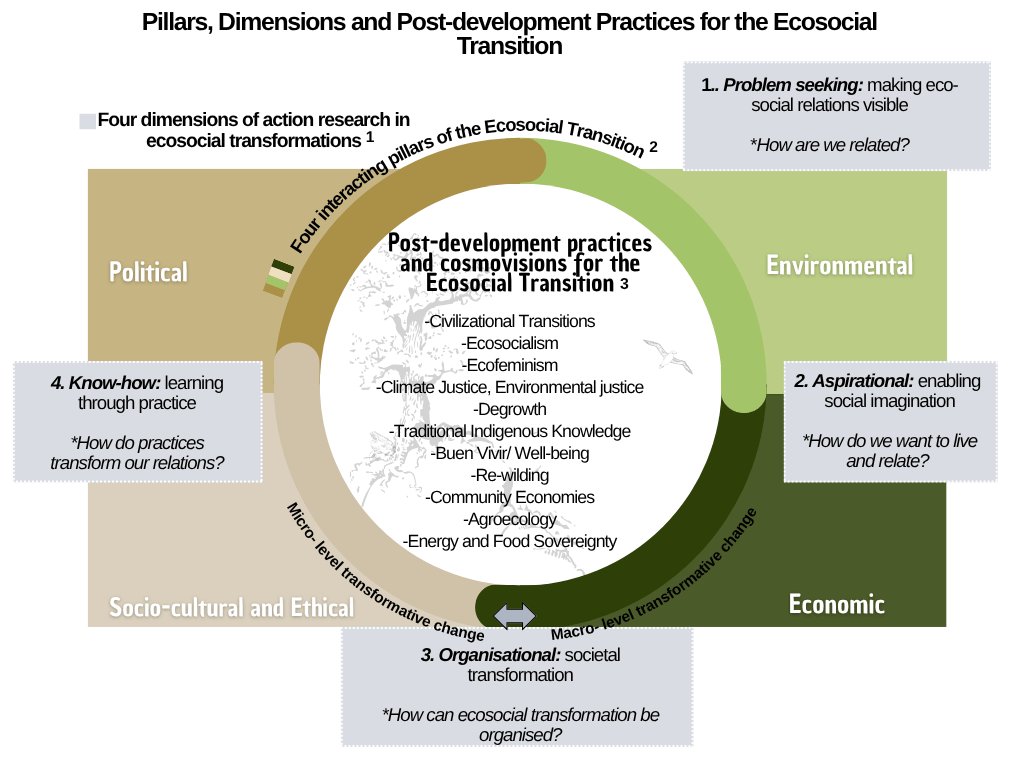
Ecosocial transitions must be multiple and situated, shaped by diverse epistemological traditions that converge towards justice, care, and sustainability, in sharp contrast to a capitalist development model that presents itself as universal while disregarding local cultures and political systems. In Latin America, this has given rise to interdisciplinary perspectives articulating critical, decolonial, and territorial readings of the crisis (Ferreira et al., 2006; Segato, 2007; Mardones Barrera, 2016; Truchet-Aznar et al., 2025), encompassing Marxist materialism, constructivist theories, political ecology, and decolonial feminism. The following exemplify the most significant currents within the ‘Pluriverse’ (Kothari et al., 2019).
Ecosocialism, particularly Riechmann et al.’s (2018) ‘Barefoot Ecosocialism’, advocates post-fossil, low-tech societies guided by austerity and the fulfilment of basic needs within planetary boundaries. Ecofeminism links the domination of women and the exploitation of nature as interconnected outcomes of patriarchal and capitalist systems, urging a revaluation of care and relational practices (Mies & Shiva, 1993). The climate and environmental justice frames climate change as a justice issue, warning that without equity, mitigation strategies risk deepening inequalities through energy costs, forced displacement, and exclusion from decision-making (Resnik, 2022). Degrowth proposes a planned reduction of energy and resource use, rejecting infinite growth in favour of equity, sustainability, and collective well-being, particularly addressing North-South asymmetries (Hickel, 2020). Indigenous and traditional knowledges, such as the Andean ‘Buen Vivir’, embody centuries of co-evolution with nature through holistic ecological, technological, and cosmological worldviews (Gavilán Pinto, 2012). Finally, food and energy sovereignty challenge dependence on privatised global markets, asserting communities’ rights to manage land, seeds, water, and energy as commons (Del Bene et al., 2019; Gutiérrez Escobar, 2019). Together, these currents form an integrative framework that bridges critical reflection, collective imagination, and transformative action towards socially and environmentally just futures.
Communicating for the Ecosocial Transition
In this sense, communication plays a crucial role in advancing ecosocial transition processes by shaping collective imaginaries and enabling social transformation. While related traditions such as participatory communication and communication for social change, exemplified by the Latin American ‘educomunicación’ legacy, have conceived communication as a liberating, community-based practice oriented towards empowerment and the common good (Kaplún, 1987), ecosocial communication extends this foundation in three significant ways. First, it situates communication within a civilisational and systemic diagnosis rather than a sectoral one, addressing not isolated environmental or social problems but the structural logic that generates them. Second, it draws on plural epistemologies, particularly from the Global South, as constitutive of the framework itself instead of mere case studies. Third, it proposes communication as an ontological praxis (Escobar & Chaparro, 2020): not merely a tool for dissemination but as the very act of co-constructing alternative worlds. In this way, ecosocial communication moves beyond frameworks that work within existing development paradigms, explicitly rejecting the growth model and the commodification of life that underpins it.
It has the essential task of counteracting the prevailing storyline that there is no future beyond capitalism, that collapse is inevitable, and that individual action is futile. Against these paralysing imaginaries, its purpose is to foster awareness, civic engagement, and resistance to extractivist pressures that threaten territories and communities. As Herrero (2024) argues, imagination plays a vital role in collective transition processes, as it allows societies to envision fair and sustainable futures within the ecological limits of the planet. Therefore, this section addresses RQ2: What roles can communication play in advancing ecosocial transition processes? It proposes that the role of communication for ecosocial transition is to recover the narrative of possible ecosocial futures and to open pathways for collective transformation.
Recovering the Narrative: From Eco-dystopian Imaginaries to Ecosocial Transitions
Narratives, as a fundamental component of human communication, play a crucial role in conveying meaning around environmental issues. Through them, people communicate experiences, beliefs, and cultural worldviews, providing a framework for decision-making but also shaping collective identities, perpetuating stereotypes, and restricting perspectives (Perrino, 2023). This imaginative capacity is nourished by the discourses, symbols, and narratives embedded in media culture, which Kellner (2020) identifies as systems of ideological production capable of shaping identities, values, and norms through contemporary platforms.
These imaginaries influence how societies envision the future. Numerous Hollywood productions of recent decades, such as Don’t Look Up (2021), Snowpiercer (2013), and The Day After Tomorrow (2004), reinforce apocalyptic imaginaries in which catastrophe appears inevitable, and humanity faces near extinction as a result of environmental collapse and political inaction. More recently, these narratives have merged with dystopian explorations of artificial intelligence and techno-authoritarianism, as in Ex Machina (2014), Her (2013), and Interstellar (2014), where algorithmic control and planetary escape emerge as symbols of civilisation’s failure to coexist with the living world. Inspirational or utopian narratives envisioning ecosocial futures remain far less common, revealing the difficulty of collectively imagining hopeful horizons amid ecological crisis.
The cultural impact of such dystopian productions is significant yet ambivalent. While they can attract attention and raise awareness, they may equally foster fear, distrust, or disengagement among audiences already saturated with catastrophic messages (Leiserowitz, 2004). In a media environment saturated with conflicting narratives, alarmist framings risk provoking a boomerang effect, deepening cynicism and social paralysis rather than motivating action. Several authors, therefore, highlight the importance of coupling alarming content with messages of efficacy and credible pathways for change (Leiserowitz, 2004; Nisbet, 2011).
This points to a deeper problem: the contemporary civilisational narrative is itself in crisis. As Mark Fisher contends, ‘it is easier to imagine the end of the world than the end of capitalism […] the widespread idea that capitalism is not only the only viable economic system, but that it is impossible even to imagine an alternative to it’ (Fisher, 2009, p. 13). This framework permeates media culture, where cinema, advertising, and music portray the market as a natural state of affairs rather than an ideology. Even representations of ecological collapse reproduce this logic, aestheticising catastrophe as spectacle or opportunity, as in Wall-E (2008), where capital re-emerges as capable of restoring life (Fisher, 2009, p. 32). Popular culture’s apparent critiques of capitalism frequently operate as what Fisher calls ‘interpassive anti-capitalism’, allowing audiences to experience dissent without enacting change, absorbing protest and reconfiguring it as entertainment while reinforcing resignation and consumerist despair.
Reframing the Future: From Individual Escape to Collective Transformation
In Survival of the Richest: Escape Fantasies of the Tech Billionaires, Rushkoff (2022) argues that economic elites respond to ecosocial collapse not with collective solutions but with individualist escape strategies: luxury bunkers, private enclaves in places like New Zealand or Hawai’i, and fantasies of digital immortality. Examples include Mark Zuckerberg’s bunker in Hawai’i, Peter Thiel’s plans in New Zealand, and the extravagant shelters of influencers such as the Tate brothers and MrBeast (Baxter, 2025). Transcending this elitist worldview requires, he concludes, rediscovering community, mutual aid, and human interdependence as the only real path to survival.
Recovering the narrative is the central task of communication for the ecosocial transition. This requires what Escobar and Chaparro (2020) describe as an ‘ontological praxis in communication’, restoring the original sense of communicare: to share, to relate, and to build community. Communication thus becomes a living, relational practice that transcends media enterprises or digital platforms, creating spaces of collective imagination and the co-creation of alternative imaginaries grounded in care, coexistence, and the common good. It also assumes a narrative function, making visible transformative worldviews and linking the ecosocial crisis to lived experiences through action-based storytelling (Meyer et al., 2020).
New narrative frameworks such as Gómez’s Collective Journey (2019) move beyond the individualistic Hero’s Journey towards collective, participatory storytelling in which the protagonist is a community, the antagonist is structural, and change emerges from solidarity rather than exceptional individuals, generating affective bonds, shared meaning, and processes of social self-organisation.
In line with Jenkins et al.’s (2020) concept of civic imagination, the role of communication ultimately lies in making ongoing transitions visible, from renewable energy cooperatives to sustainable transport and responsible consumption networks, demonstrating that change is neither utopian nor deferred but an active and tangible process already underway (Chaparro Escudero et al., 2020).
Practices of Communication for Ecosocial Transition
Across diverse contexts, these four cases illustrate how communication for ecosocial transition operates as a relational, participatory, and transformative practice. The study of Serna et al. (2024) exemplifies the community transition dimension of ecosocial communication, showing how everyday communicative practices sustain collective imagination and structural change. The study examines community-based initiatives in Spain: the processes of neo-ruralisation and natural wine production (Western Sierra of Madrid and Southern Sierra de Gredos), the agroecological supply systems (Catalonia), and the community urban gardens integrated into a Municipal Program (Madrid). These initiatives promote alternative ways of inhabiting, producing, and consuming. Crucially, transformation arises from within everyday communicative acts embedded in collective practice: weekly assemblies negotiating food prices between producers and consumers, WhatsApp networks that reorganised agroecological supply chains during the COVID-19 lockdowns, festivals linking agroecological products to cultural identity, and soil care workshops that produce new shared temporalities and ethical sensibilities. These communicative practices are analytically significant because they do not merely ‘spread information’ about ecosocial transition; they enact it by co-constructing alternative ontologies of nature-society relations from within daily life. At the same time, the study documents important limits: these initiatives are embedded in capitalist market logics they cannot fully escape; institutional support remains fragile and discontinuous; and participation tends to reproduce class and cultural biases despite aspirations to inclusivity – tensions that ecosocial communication must engage transparently rather than idealise.
In Ecuador, Alli Kawsaipak Jampikuna/Medicine for Good Living (Tornay Márquez, 2020) embodies an educommunicative approach that integrates local wisdom, spirituality, and environmental justice, turning communication into a space of healing, learning, and cultural autonomy. The intervention trained Indigenous women healers from the Corporación de Taitas y Mamas del Chimborazo to produce a pilot radio programme broadcast on the Kichwa-language community station Escuelas Radiofónicas Populares del Ecuador (ERPE) in Riobamba. The communicative form chosen (participatory radio in the Indigenous language, produced by and for the community, grounded in ancestral healing knowledge) is itself an ecosocial communicative act: it restores epistemic authority to knowledges historically inferiorised by colonial science and patriarchal power, and it enacts Buen Vivir not as an abstract concept but as a programme about plant medicine and community care. The experience also revealed structural obstacles such as patriarchal barriers to women’s public speech, discriminatory institutional logics, and precarious access to technology. These logics underscore the material conditions ecosocial communication must contend with. At the level of communication practice, this case demonstrates that the medium, the language, the speaker, and the knowledge system are all dimensions of the communicative form, and it matters who has access to telling stories, from what frameworks of thought, and on what platforms and channels.
Similarly, community-supported agriculture initiatives such as La Vía Campesina (The Peasant Way) connect international networks for food sovereignty across Latin America, Europe, and Africa and illustrate how food sovereignty operates as an explicitly communicative project. Rosset and Martínez-Torres (2013) document how LVC’s peasant-to-peasant methodology functions as a horizontal knowledge-exchange practice that simultaneously transmits agroecological techniques and produces counter-hegemonic ideological consensus against corporate food regimes and agrarian power relations. Communication here is the constitutive practice through which peasant subjectivity and solidarity are produced and reproduced. LVC’s use of community media, international solidarity networks, and narrative reframing, contrasting ‘the green deserts’ of industrial monoculture with the image of diverse campesino agroecology, represents ecosocial communication in its most explicitly counter-hegemonic mode. These initiatives act as spaces of politicisation and resistance, using community media, newsletters, markets, and festivals to link sustainability with cultural and structural transformation. Yet this communicative model faces structural limits. Horizontal knowledge exchange depends on sustained organisational infrastructure, and when funding cycles end, gains tend to revert. Moreover, as agroecology gains visibility, its communicative framing risks co-optation by greenwashing strategies that strip it of its political and territorial content (Rosset and Martínez-Torres, 2013).
Finally, the Kichwa community of Sarayaku in Ecuador exemplifies a comprehensive communicative strategy that integrates ontological assertion, legal advocacy, and Indigenous audiovisual production to defend their territory from extractivism. The Kawsak Sacha declaration, defining the Amazon rainforest as a living, thinking, and conscious being with rights, functions simultaneously as a cosmological claim, a legal-political instrument, and a communicative framework that anchors all of Sarayaku’s public action. What makes this case analytically distinctive for ecosocial communication is the way this declaration challenges the anthropocentrism underpinning both extractivist propaganda and conventional environmental communication, insisting instead on an ontology in which non-human entities are communicative agents rather than mute resources. Sarayaku’s appropriation of audiovisual technology through Eriberto Gualinga’s Selvas Producciones, the institutional communication body Waktachi, and digital platforms constitutes what Vanegas-Toala (2020) terms ‘ecoterritorial communicative praxis’: the use of contemporary media tools to assert a biocentric ontology irreducible to Western environmentalism. The community’s experience equally documents the material conditions of communicative vulnerability, including the need for institutional infrastructure built incrementally since the Caso Sarayaku, the risks of co-optation by NGOs and carbon market intermediaries, and the persistent tension between accessing global media visibility and maintaining communicative autonomy from narratives that frame oil exploitation as development (Ruales Flores, 2024).
Together, these experiences reveal that communication for ecosocial transition operates as a relational, participatory, and transformative practice: one that co-constructs alternative ontologies of nature-society relations (Serna et al., 2024), restores epistemic authority to historically inferiorised knowledges (Tornay Márquez, 2020), produces counter-hegemonic subjectivities and solidarities (Rosset and Martínez-Torres, 2013), and asserts the communicative agency of non-human entities as a condition of territorial and political struggle (Vanegas-Toala, 2020). Across all four cases, communication is not merely a vehicle for disseminating ecosocial imaginaries but the very practice through which they are enacted.
It is therefore possible to affirm that the ecosocial approach expands the boundaries of the field precisely because communication is understood not only as a vehicle for spreading ideas but also as the practice through which alternative worlds are enacted. It moves beyond media-centred or risk-based framings towards transformative, participatory, and community-driven modes of communication that reimagine the relationship between humans, technology, and the living world. However, communication for the ecosocial transition faces challenges that extend far beyond the complex task of imagining futures beyond capitalism. These challenges are deeply intertwined with the dynamics of the contemporary media ecosystem, an environment dominated by platformisation, the attention economy, disinformation, and data extraction, which privileges the most sensationalist and negative content.
In a communicative landscape where users spend an average of six hours per day on digital devices (Kemp, 2023) and algorithms determine cultural visibility, data have become the central commodity of an economy driven by targeted advertising and platform optimisation (Bergemann & Bonatti, 2024). As a result, both media organisations and independent creators operate within systems where visibility is increasingly governed by opaque algorithmic logics and commercial agreements rather than by the social relevance or quality of content (Bartlett et al., 2023; Duffy et al., 2019).
This dependence on digital platforms contributes to a broader process of civic atomisation, transforming citizens into spectators within what Sampedro (2018) describes as a form of ‘digital capitalism’, a model sustained by hyperconnectivity, data extractivism, and an overabundance of trivial information that distracts from issues of real social consequence. The growing influence of technological oligopolies on global politics and public discourse, as illustrated by Elon Musk’s interference in the 2024 US elections, underscores how these corporations act as powerful mediators of collective imaginaries.
Within such environments, comment sections and social interactions often function as echo chambers rather than spaces for deliberation or correction, reinforcing polarisation and amplifying denialist narratives, such as the persistence of climate change denial in countries where scientific consensus is strongest (Walter et al., 2018). Ultimately, as Rhodes (2022) warns, social-media platforms have become the primary gateways for misinformation, where algorithmic filter bubbles intensify falsehoods and obstruct the emergence of informed, transformative dialogue essential for an ecosocial transition. Taken together, these reflections address RQ3: What contributions and challenges does this perspective pose for the field and practice of environmental communication?
Conclusions
This study has proposed a theoretical and interpretive framework for rethinking environmental communication through an ecosocial lens. Evolving from managing risk or disseminating information, communication for the ecosocial transition is tasked with recovering narratives of possible futures and opening collective pathways from dystopian resignation towards hopeful and actionable horizons. This requires overcoming what the framework identifies as ‘interpassive anti-capitalism’, the tendency of media culture to absorb dissent as entertainment, reinforcing consumerist despair rather than enabling transformation. Against this, ecosocial communication proposes an ontological praxis oriented towards the common good: making visible the plurality of alternative futures, coupling alarming content with credible pathways for change, and rediscovering community and mutual aid as conditions of survival.
The four cases illustrate that this is not merely theoretical. Communication for ecosocial transition co-constructs alternative ontologies of nature-society relations, restores epistemic authority to historically inferiorised knowledges, produces counter-hegemonic subjectivities through horizontal knowledge exchange, and asserts the communicative agency of non-human entities as a condition of territorial struggle. Across all four cases, the ‘hero’ is a collective subject embodying solidarity, while the antagonist is not an individual but the structural systems (capitalism, patriarchy, and colonialism) that perpetuate inequality and ecological disconnection. Communication becomes, in this sense, a living, relational, and liberating practice (Kaplún, 1987).
At the same time, the analysis reveals a structural paradox: ecosocial communicative practices must navigate and contest the very infrastructures governed by platformisation, data extractivism, and attention-economy logics that reproduce the inequalities they seek to transform. Institutional support proves fragile; participation tends to reproduce class and cultural biases; patriarchal barriers, discriminatory logics, and precarious technology access persist. As transformative practices such as agroecology gain communicative visibility, their framing risks co-optation by greenwashing strategies that strip them of their political and territorial content. Indigenous practices face the persistent tension between global visibility and autonomy from extractivist narratives.
These are constitutive tensions ecosocial communication must engage transparently rather than idealise, for its role ultimately lies in co-constructing imaginaries of dwelling and relation, making visible ongoing transitions, demonstrating that change is neither utopian nor deferred but active and tangible while building the communicative resilience needed to resist disinformation, corporate capture, and algorithmic invisibility.
As a largely theoretical exploration, this study’s main limitation lies in its conceptual nature. Future research should examine how ecosocial communication operates across diverse cultural, linguistic, and media contexts, exploring how communities negotiate digital dependencies, build communicative resilience, and articulate the pedagogical and aesthetic dimensions of ecosocial storytelling. Communication for the ecosocial transition must continue to evolve as a field capable of bridging theory and action, imagination and transformation.
Acknowledgements
This work is part of the R&D Project “Media responsibility indicator for the communication of ecosocial transitions” (IMRESCOM; PID2022-140281OB-I00), University of Málaga, Spain.
Competing Interests
The author has no competing interests to declare.
References
Abdullah, K. H. (2023). An analysis of publications on climate change communication using a bibliometric lens. Fronteiras, 12(3), 354–371. http://doi.org/10.21664/2238-8869.2023V12I3.P354-371
Acosta, A., et al. (2023). Más allá del colonialismo verde: Justicia global y geopolítica de las transiciones ecosociales. Buenos Aires, Argentina: CLACSO. https://biblioteca-repositorio.clacso.edu.ar/handle/CLACSO/249068
Agin, S. & Karlsson, M. (2021) Mapping the field of climate change communication 1993–2018: Geographically biased, theoretically narrow, and methodologically limited. Environmental Communication, 15(4), 431–446. http://doi.org/10.1080/17524032.2021.1902363
Akerlof, K. L., Timm, K. M., Rowan, K. E., Olds, J. L., & Hathaway, J. (2022). The growth and disciplinary convergence of environmental communication: A bibliometric analysis of the field (1970–2019). Frontiers in Environmental Science, 9, 814599. http://doi.org/10.3389/fenvs.2021.814599
Arons, W. (2023). We should be talking about the Capitalocene. TDR: The Drama Review, 67(1), 35–40. http://doi.org/10.1017/S1054204322000697
Asmi, F., Anwar, M. A., Zhou, R., Wang, D., & Sajjad, A. (2019). Social aspects of climate change communication in the 21(st) century: A bibliometric view. Journal of Environmental Planning and Management, 62(14), 2393–2417. http://doi.org/10.1080/09640568.2018.1541171
Ballantyne, A. G. (2016). Climate change communication: What can we learn from communication theory? Wiley Interdisciplinary Reviews-Climate Change, 7(3), 329–344. http://doi.org/10.1002/wcc.392
Bartlett, M., Morreale, F., & Prabhakar, G. (2023). Analysing privacy policies and terms of use to understand algorithmic recommendations: The case studies of Tinder and Spotify. Journal of the Royal Society of New Zealand, 53(1), 119–132. http://doi.org/10.1080/03036758.2022.2064517
Baxter, H. (2025). Apocalypse now? Why tech billionaires are suddenly hoarding doomsday mega-bunkers: “Don’t take the stripper poles out”. The Independent, September 3 (online). https://www.independent.co.uk/news/world/americas/mega-bunkers-tech-billionaires-why-builder-b2814490.html
Bergemann, D. & Bonatti, A. (2024). Data, competition, and digital platforms. American Economic Review, 114(8), 2553–2595. http://doi.org/10.1257/aer.20230478
Brand, U., & Wissen, M. (2013). Crisis and continuity of capitalist society–nature relationships: The imperial mode of living and the limits to environmental governance. Review of International Political Economy, 20(4), 687–711. https://www.jstor.org/stable/42003258
Brand, U., & Wissen, M. (2017). Social-Ecological Transformation. In D. Richardson, N. Castree, M. F. Goodchild, A. Kobayashi, W. Liu, & R. Marston (Eds.), The International Encyclopedia of Geography (pp. 1–10). Oxford, UK: Wiley-Blackwell. http://doi.org/10.1002/9781118786352.wbieg0690
Braun, B. (2015). Futures: Imagining socioecological transformation – an introduction. Annals of the Association of American Geographers, 105(2), 239–243. http://doi.org/10.1080/00045608.2014.1000893
Canon, C. R., Boyle, D. P., & Hepworth, K. J. (2022). Mapping pathways to public understanding of climate science. Public Understanding of Science, 31(6), 766–783. http://doi.org/10.1177/09636625221079149
Chaparro Escudero, M., Espinar Medina, L., El Mohammadiane Tarbif, A., & Peralta García, L. (2020). Guía de transición ecosocial y principios éticos para nuestros medios. Madrid, Spain: Fragua.
Chen, D., Guo, Y., Wang, C., Xu, Y., & Zhang, H. (2022). Dispersion and disparity: Bibliometric and visualized analysis of research on climate change science communication. International Journal of Environmental Research and Public Health, 19(23), 15766. http://doi.org/10.3390/ijerph192315766
Comfort, S. E., & Park, Y. E. (2018). On the field of environmental communication: A systematic review of the peer-reviewed literature. Environmental Communication, 12(7), 862–875. http://doi.org/10.1080/17524032.2018.1514315
Del Bene, D., Soler, J. P., & Roa, T. (2019). Soberanía energética. In A. Escobar, A. Kothari, F. Demaria & A. Acosta (Eds.) Pluriverso. Un diccionario del posdesarrollo (pp. 178–181). Barcelona, Spain: Icaria Editorial.
Demaria, F., Acosta, A., Kothari, A., Salleh, A., & Escobar, A. (2021). El pluriverso, horizontes para una transformación civilizatoria. Revista De Economía Crítica, 1(29), 46–66. https://revistaeconomiacritica.org/index.php/rec/article/view/249
Drimili, E., Gareiou, Z., & Zervas, E. (2019). Analysis of the world scientific production on public’s opinion on environmental issues. Environmental Research and Technology, 2(4), 171–182. http://doi.org/10.35208/ert.582337
Duffy, B. E., Poell, T., & Nieborg, D. B. (2019). Platform practices in the cultural industries: Creativity, labour, and citizenship. Social Media + Society, 5(4), 1–8. http://doi.org/10.1177/2056305119879672
Egmose, J., Hauggaard-Nielsen, H., & Jacobsen, S. G. (2022). Action research in the plural crisis of the living: Understanding, envisioning, practicing, organising eco-social transformation. Educational Action Research, 30(4), 671–683. http://doi.org/10.1080/09650792.2022.2084433
Escobar, A., & Chaparro, M. (2020). Divergencias, alternativas y transiciones de los modelos y las comunicaciones para el buen vivir. Chasqui. Revista Latinoamericana de Comunicación, 144, Article 144. http://doi.org/10.16921/chasqui.v0i144.4375
Escobar, A. (2007). Invención Del Tercer Mundo. Construcción Y Deconstrucción Del Desarrollo. Caracas, Venezuela: Fundación Editorial el perro y la rana.
Escobar, A. (2012). Más allá del desarrollo: Postdesarrollo y transiciones hacia el pluriverso. Revista de Antropología Social, 21(0), 23–62. http://doi.org/10.5209/rev_RASO.2012.v21.40049
Ferreira, L., Ferreira, C., Seixas, S., Barbosa, C., Hoeffel, J., De, L., Hoefel, M., Floriani, D., & Tavolaro, S. (2006). Environmental issues, interdisciplinarity, social theory and intellectual production in Latin America. Ambiente & Sociedade IX: 9–24. http://doi.org/10.1590/S1414-753X2006000200001
Fisher, M. (2009). Capitalist Realism: Is There No Alternative? Winchester: Zero Books.
Gavilán Pinto. V, M. (2012). El pensamiento en espiral. El paradigma de los pueblos indígenas. Temuco, Chile: Editorial Ñuque Mapuforlaget.
Gómez, J. (2019). The collective journey comes to television. Medium, September 16. https://blog.collectivejourney.com/the-collective-journey-story-model-comes-to-television-151bb4011ce2
Gutiérrez Escobar, L. (2019). Soberanía alimentaria. In A. Escobar, A. Kothari, F. Demaria & A. Acosta (Eds.) Pluriverso. Un diccionario del posdesarrollo (pp. 185–188). Barcelona, Spain: Icaria Editorial.
Hansen, A. (2011). Communication, media, and environment: Towards reconnecting research on the production, content and social implications of environmental communication. International Communication Gazette 73(1–2): 7–25. http://doi.org/10.1177/1748048510386739
Hartmann, H., Henrici, J., Childers, C., & Shaw, E. (2015). Foreword. In Get to the Bricks: The Experiences of Black Women from New Orleans Public Housing after Hurricane Katrina (pp. iii–iv). Washington, DC: Institute for Women’s Policy Research. http://www.jstor.org/stable/resrep27079.2
Herrero, Y. (2006). El Movimiento Ecologista Ante El Deterioro Global: Retos Y Utopías. Psychosocial Intervention, 15(2), 149–166. http://doi.org/10.4321/s1132-05592006000200003
Herrero, Y. (2024). Transición Ecosocial Justa. Vol. Dossieres EsF n.º 52, Buenos Aires, Argentina: Economistas sin Fronteras. https://ecosfron.org/portfolio/transicion-ecosocial-justa/
Hickel, J. (2020). Less Is More. How Degrowth Will Save The World. London, UK: William Heinemann.
Höijer, B. (2010). Emotional anchoring and objectification in the media reporting on climate change. Public Understanding of Science, 19(6), 717–731.
Ihobe (2018). Guía Rápida para Periodistas sobre Cambio Climático. Sociedad Pública de Gestión Ambiental Departamento de Medio Ambiente, Planificación Territorial y Vivienda Gobierno Vasco, Bilbao, Spain: Ihobe. https://www.apmadrid.es/wp-content/uploads/2020/09/Dosier_tecnico_Cambio_Climatico_ihobe_para_periodistas_web.pdf
Jenkins, H., Shresthova, S., & Peters-Lazaro, G. (Eds.). (2020). Popular Culture and the Civic Imagination: Case Studies of Creative Social Change. New York, NY: NYU Press.
Kaplún, M. (1987). El comunicador popular (2.ª ed.), Buenos Aires, Argentina: Editorial Lumen Humanitas.
Kellner, D. (2020). Media Culture: Cultural Studies, Identity, and Politics in the Contemporary Moment (2nd ed.). London, UK: Routledge.
Kemp, S. (2023). Digital, 2023: Global Overview Report. DataReportal. https://datareportal.com/reports/digital-2023-global-overview-report
Kothari, A., Salleh, A., Escobar, A., Demaria, F., & Acosta, A. (2019). Pluriverso. Un Diccionario del Posdesarrollo. Barcelona, Spain: Icaria Editorial.
Larocque, E. (2023). Co-envisioning the social-ecological transition through youth eco-activists’ narratives: Toward a relational approach to ecological justice. Journal of Community Practice, 31(2), 127–151. http://doi.org/10.1080/10705422.2023.2208577
Laurent, E., & Pochet, P. (2015). Towards a Social-Ecological Transition. Solidarity in the Age of Environmental Challenge. Brussels, Belgium: The European Trade Union Institute ETUI. https://www.etui.org/publications/guides/towards-a-social-ecological-transition-solidarity-in-the-age-of-environmental-challenge
La Vía Campesina. (2017). Publicación: Las Luchas de La Vía Campesina por la Reforma Agraria, la defensa de la vida, la tierra y los territorios. Harare, Zimbabwe: La Vía Campesina. https://viacampesina.org/es/publicacion-las-luchas-la-via-campesina-la-reforma-agraria-la-defensa-la-vida-la-tierra-los-territorios/
Leff, E. (2004). Racionalidad ambiental: la reapropiación social de la naturaleza. Mexico, DF: Siglo XXI.
Leiserowitz, A. A. (2004). Day after tomorrow: study of climate change risk perception. Environment: Science and Policy for Sustainable Development, 46(9), 22–39. http://doi.org/10.1080/00139150409603663
Mardones Barrera, R. E. (2016). Discurso Del Territorio Enunciado Por Las Ciencias Sociales En Las Publicaciones Científicas De Revistas Latinoamericanas. Prisma Social, 16, 556–596. https://revistaprismasocial.es/article/download/1266/1328
Meléndez, L. V., Labrada, G. C. G., & Valdés, J. C. C. (2024). El abordaje científico de las epistemologías del sur: Una revisión bibliométrica. Estudios del Desarrollo Social: Cuba y América Latina, 12(2), 96–109. https://revistas.uh.cu/revflacso/article/view/9281
Meyer, K. D., Coren, E., McCaffrey, M., & Slean, C. (2020). Transforming the stories we tell about climate change: From ‘issue’ to ‘action’. Environmental Research Letters, 16(1), 015002. http://doi.org/10.1088/1748-9326/abcd5a
Mies, M., & Shiva, V. (1993). Ecofeminism. London, UK: Zed Books.
Nisbet, M. C. (2011). Climate shift: Clear vision for the next decade of public debate. Washington, DC: American University School of Communication. ClimateShiftProject.org.
Perrino, S. M. (2023). Narrative in Sociocultural Studies of Language. In Oxford Research Encyclopedia of Anthropology. Oxford, UK: Oxford University Press. http://doi.org/10.1093/acrefore/9780190854584.013.589
Pezzullo, P. C. (2023). Beyond Straw Men: Plastic Pollution and Networked Cultures of Care. Oakland, CA: University of California Press.
Phillips, C. A., Caldas, A., Cleetus, R., Dahl, K. A., Declet-Barreto, J., Licker, R., Merner, D., Ortiz-Partida, J. P., Phelan, A. L., Spanger-Siegfried, E., Talati, S., Trisos, C. H., & Carlson, C. J. (2020). Compound climate risks in the COVID-19 pandemic. Nature Climate Change, 10(7), 586–593. http://doi.org/10.1038/s41558-020-0804-2
Pleasant, A., Good, J., Shanahan, J., & Cohen, B. (2002). The literature of environmental communication. Public Understanding of Science, 11(2), 197–205. http://doi.org/10.1177/096366202129084868
Rafida, A. R. N., & Norailis, A. W. (2024). Foresight of environmental communication literatures: Bibliometric versus ChatGPT. Foresight, 26(5), 966–983. http://doi.org/10.1108/FS-12-2023-0253
Resnik, D. B. (2022). Environmental justice and climate change policies. Bioethics, 36(7), 735–741. http://doi.org/10.1111/bioe.13042
Rhodes, S. C. (2022). Filter bubbles, echo chambers, and fake news: How social media conditions individuals to be less critical of political misinformation. Political Communication, 39(1), 1–22. http://doi.org/10.1080/10584609.2021.1910887
Riechmann, J. (2016). El no actuar en aquellos días. Madrid, Spain: Foro Transiciones.
Riechmann, J., Ruiz, A. M., & Redondo, Ó. C. (2018). Para evitar la barbarie: Trayectorias de transición ecosocial y de colapso. Granada, Spain: Universidad de Granada. https://dialnet.unirioja.es/servlet/libro?codigo=726194
Ripple, W. J., Wolf, C., Newsome, T. M., Barnard, P., & Moomaw, W. R. (2019). World scientists’ warning of a climate emergency. BioScience, 70(1), 8–12. http://doi.org/10.1093/biosci/biz088
Rosset, P., & Martínez-Torres, M. E. (2013). La Vía Campesina y Agroecología. In Libro abierto de la Vía Campesina, celebrando, 20. Harare, Zimbabwe: La Vía Campesina. https://www.viacampesina.org/es/wp-content/uploads/sites/3/2013/05/ES-09.pdf
Ruales Flores, D. P. (2024). Kawsak sacha: Prácticas comunicacionales del pueblo sarayaku hacia el cambio ecosocial. Bachelor’s Thesis. http://dspace.ups.edu.ec/handle/123456789/27258
Rushkoff, D. (2022). Survival of the Richest: Escape Fantasies of the Tech Billionaires. New York, NY: W. W. Norton & Company.
Sampedro, V. (2018). Dietética digital: Para adelgazar al Gran Hermano. Madrid, Spain: Foro Transiciones. https://dieteticadigital.net/
Schäfer, M. S., & Schlichting, I. (2014). Media representations of climate change: A meta-analysis of the research field. Environmental Communication, 8(2), 142–160. http://doi.org/10.1080/17524032.2014.914050
Segato, R. (2007). La nación y sus otros: Raza, etnicidad y diversidad religiosa en tiempos de políticas de la identidad. Buenos Aires, Argentina: Prometeo Libros.
Senecah, S. L. (2007). Impetus, mission, and future of the environmental communication commission/division: Are we still on track? Were we ever? Environmental Communication, 1(1), 21–33. http://doi.org/10.1080/17524030701334045
Seneviratne, S. I., et al. (2021). Weather and climate extreme events in a changing climate. In V. Masson-Delmotte et al. (Eds.), Climate Change 2021: The Physical Science Basis. Contribution of Working Group I to the Sixth Assessment Report of the Intergovernmental Panel on Climate Change (pp. 1513–1766). Cambridge, UK: Cambridge University Press. http://doi.org/10.1017/9781009157896.013
Serna, D. B., Acedo, S. S., & Piscina, P. H. R. de la. (2024). Habitar, consumir y cultivar. Procesos e iniciativas para la transición ecosocial en Cataluña y Madrid. Revista Española de Sociología, 33(3), Article 3. http://doi.org/10.22325/fes/res.2024.236
Shaid, N., Abidin, M. Z. Z., & Shamsuddin, F. (2023). Online media framing of the Sungai Kim Kim chemical spill and the effect on public sentiment. SEARCH Journal of Media and Communication Research, 15(2), 17–52. http://search.taylors.edu.my
Tornay Márquez, M. C. (2020). Alli Kawsaipak Jampikuna/Medicina para el buen vivir. Una experiencia radiofónica por parte de mujeres indígenas ecuatorianas. In E. Nava Morales (Ed.) Tejiendo desde la contrahegemonía: Medios, redes y TIC en América Latina (pp. 59–85). Mexico City: Instituto de Investigaciones Sociales/Universidad Nacional Autónoma de México. https://ru.iis.sociales.unam.mx/handle/IIS/5818
Truchet-Aznar, S., Aubert, F., Aznar, O., & Davi, B. (2025). How does regional science address environmental issues? A bibliometric analysis of two decades of publications. International Regional Science Review, 48(3), 271–305. http://doi.org/10.1177/01600176241267206
Vanegas-Toala, V. (2020). Comunicación y el giro ecoterritorial en red campo-ciudad. In N. Medranda-Morales & N. Valbuelna-Bedoya (Eds.) Comunicación y ciudad. Lenguajes, actores y relatos. Quito, Ecuador: Abya-Yala.
Walter, S., Brüggemann, M., & Engesser, S. (2018). Eco-denial chambers: Explaining user comments on climate change. Environmental Communication, 12(2), 204–217. http://doi.org/10.1080/17524032.2017.1394893
Wu, M., Long, R., Bai, Y., & Chen, H. (2021). Knowledge mapping analysis of international research on environmental communication using bibliometrics. Journal of Environmental Management, 298, 113475. http://doi.org/10.1016/j.jenvman.2021.113475
Wu, M., Long, R., Yang, S., Wang, X., & Chen, H. (2022). Evolution of the knowledge mapping of climate change communication research: Basic status, research hotspots, and prospects. International Journal of Environmental Research and Public Health, 19(18), 11305. http://doi.org/10.3390/ijerph191811305